- Want the cheapest automatic in India — nothing else undercuts it on price
- Are a new driver — the tall-boy view, small size, and clear bonnet make it genuinely beginner-friendly
- Need a no-stress second car for the city — light, peppy, and easy to park
- Value proven Maruti reliability — the K10C runs for years on minimal upkeep
- Drive mostly short city trips where an AMT and a small engine are all you need
- Do regular highway runs — 64 BHP and an AMT are built for the city, not the expressway
- Carry rear passengers on long drives often — under-thigh support runs out quickly
- Want smooth automatic shifts — the AMT nods and pauses unless you lift off the throttle
- Prioritise crash safety above all — this is an entry car and its safety credentials reflect that
- Want a car you aspire to — this is a rational purchase, not an emotional one
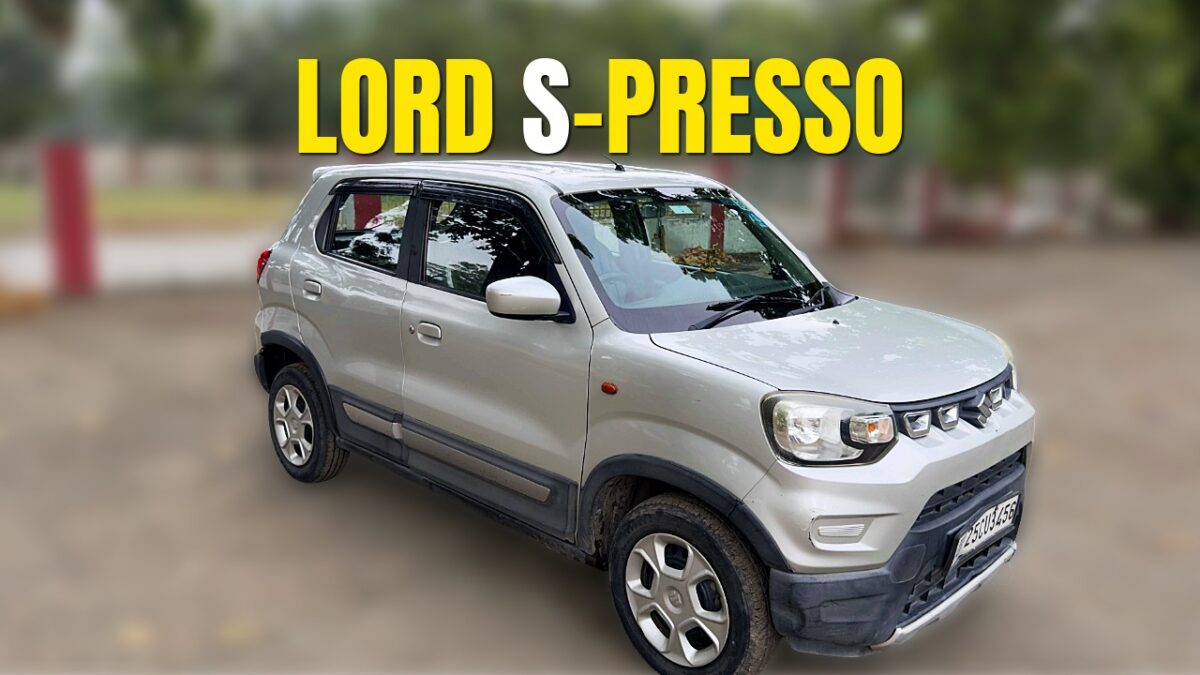
The Maruti Suzuki S-Presso VXI(O) AMT has one number that ends most arguments: it’s the cheapest automatic car you can buy in India. Around ₹4.75 lakh ex-showroom, roughly ₹5.30 lakh on-road. If you’ve been priced out of every other automatic and you’re tired of the clutch in city traffic, this is where the automatic dream actually starts.
That single fact defines who this car is for and who it isn’t. This isn’t a machine you buy because you fell in love with it. You buy it because it solves a specific problem — a first automatic for a new driver, a no-stress second car for the city, or a tall, easy-to-see-out-of runabout for someone who wants simplicity over everything. Judged against that brief, it’s very good. Judged against anything else, it was never trying.
And because the typical S-Presso buyer is often buying their first car — frequently with cash, frequently without someone experienced alongside them — this is the buyer who most needs to inspect properly before signing. If the S-Presso is on your list, the Maruti Suzuki PDI Master Blueprint is the inspection guide we’d want before any Maruti delivery. We’ll get to exactly what to check below.
The cheapest automatic in India — what that actually buys
The S-Presso’s headline is its AMT. Maruti calls it AGS — Auto Gear Shift — and it’s an automated manual, not a torque converter. That distinction matters, and an honest review has to say so. An AMT is a manual gearbox with a robot working the clutch and shifter for you. The upside: it’s cheap, it’s mechanically simple, and it’s frugal. The downside: gearshifts come with a characteristic pause and a gentle head-nod as the robot lifts off and re-engages.
Here’s the honest framing: if you learn to lift off the accelerator slightly at the moment of the shift — the way you’d feather a manual — the AMT smooths right out. Drive it like a torque-converter automatic and stamp the throttle, and it’ll lurch. For its intended buyer, in city traffic, at city speeds, it’s completely fine and does exactly what it promises: no clutch, no stalling, no stress. Just be patient with it, and it’ll be patient with you.
The K10C engine — small, peppy, and genuinely proven
The S-Presso runs Maruti’s 1.0-litre K10C three-cylinder petrol: 64 BHP and 91 Nm. On paper that’s modest. In a car weighing just 750 kg, it’s more than enough. This is a genuinely peppy little thing in the city — light, eager, and easy to place.
The turning radius is a tiny 4.7–4.8 metres, which makes it brilliant in tight lanes and cramped parking. Combined with the tall-boy design and a clear view over the bonnet, it’s one of the most beginner-friendly cars on sale. A nervous new driver can actually see where the car ends, which is worth more than any parking sensor.
On reliability, there’s a telling detail from the video: a seven-year-old S-Presso still running well on E20 fuel. That’s the real Maruti story at this price — these engines are simple, robust, and cheap to keep alive for a decade-plus. For a first car, that predictability is worth as much as any feature.
Inside the cabin — minimalist by design, not by accident
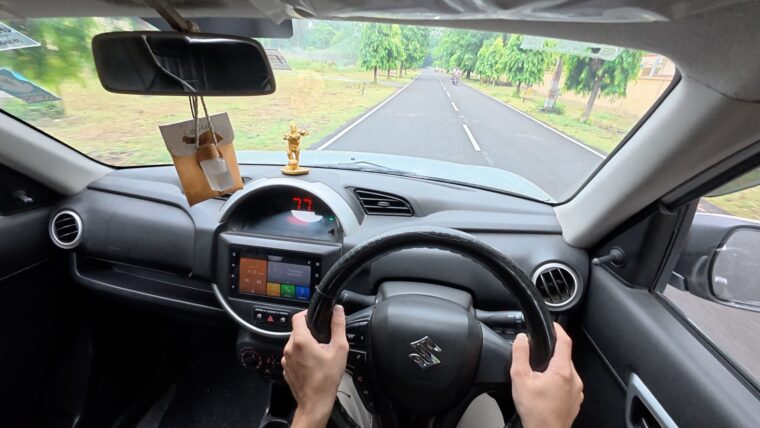
The S-Presso’s interior is utilitarian and proud of it. The centre-mounted instrument cluster is the defining quirk — polarising, but it frees up the driver’s sightline and is cheaper to engineer across left- and right-hand-drive markets.
For the price, the feature list is sensible rather than sparse: manual air conditioning, steering-mounted audio controls, wired Android Auto and Apple CarPlay, and a surprising number of storage cubbies including cup and bottle holders. The car we saw had an aftermarket reverse camera fitted, and the host rated its clarity highly — a worthwhile, cheap addition on a car like this.
The compromises are exactly where you’d expect at this price. The front seats don’t get height adjustment. Rear under-thigh support is limited on longer drives. But rear legroom and headroom are genuinely decent for the segment — the tall-boy shape pays off here — and the boot is generous relative to the car’s tiny footprint, swallowing two small bags and one large one without complaint.
S-Presso vs Alto K10 — the sibling question
The obvious cross-shop is Maruti’s own Alto K10. The two share a great deal underneath, and the honest differences are dimensional and postural. The S-Presso is about 50mm wider, noticeably taller, and generally a touch more cost-effective. The Alto K10 is the more conventional-looking small car; the S-Presso is the tall-boy with the high seating and the big glasshouse.
If you value the commanding view and easy ingress of the tall-boy shape, the S-Presso is the pick. If you’d rather a more traditional silhouette, the Alto K10 makes its case. Either way — and this matters for the next section — both cars come through the same dealer network, sit in the same stockyards, and arrive with the same delivery-day risks. The pre-delivery inspection is identical whether you’re buying an S-Presso, an Alto K10, or a Celerio.
What to check before delivery — the S-Presso, Alto K10 and Celerio PDI reality
This is the part that matters most for this buyer, because the cheapest cars in the range are the ones dealers most often use to offload problem units — and first-time buyers are the least likely to catch it. Three specific things to inspect before you pay, on any entry Maruti, whether it’s an S-Presso, Alto K10, or Celerio.
1. Old stock sold as new. Entry-level cars can sit in stockyards for months. Dealers have every incentive to move older manufacturing dates first, and a buyer who doesn’t check can drive home a car that’s already most of a year into its life — losing warranty and resale from day one. Check the manufacturing date on the VIN plate against the current month before you sign. If it’s more than a couple of months old, that’s leverage, not a dealbreaker — but you must know.
2. Bumper scrapes and body hits on the lower body. Stockyard shuffling, tight parking, and transport handling leave their marks low down — bumper corners, sill edges, the bottom third of the doors. Buyers inspect the polished upper panels and miss the lower body entirely. Walk the full lower perimeter of the car in daylight, after a wash, before accepting delivery.
3. Rust on panels, hooks, and joints in the boot and bonnet. This is the one almost nobody checks. Open the boot and bonnet and look past the painted surfaces — inspect the seams, the hinges, the hooks, and the joints where panels meet. A car that has sat outdoors in a humid stockyard can show early corrosion in these hidden areas long before it appears anywhere you’d normally look. On a car you’re buying to keep for ten years, this is exactly where trouble starts.
These aren’t paranoid concerns — they’re the specific patterns we’ve seen repeated across entry-level Maruti deliveries. The full pre-delivery sequence, with photo references for what each issue actually looks like and dealer-deflection scripts for when the salesperson tries to wave you off, is in the Maruti Suzuki PDI Master Blueprint. 70+ checkpoints, ₹1,499 once, no dealership sponsorship, no upsells. On a car this affordable, it feels like a lot to add ₹1,499 — until you consider it’s the difference between catching a rusted, old-stock, scraped unit and discovering it after the cheque has cleared.
The closing call
The Maruti Suzuki S-Presso VXI(O) AMT is not a car you aspire to. It’s a car that solves a problem better than anything else at its price: it’s the cheapest automatic in India, it’s genuinely easy and unintimidating to drive, it’s frugal, and it’ll run reliably for years on minimal upkeep. For a first-time buyer, a new driver, or anyone who needs a stress-free city automatic on the tightest of budgets, nothing else does the job for the money.
Just don’t let its low price make you casual about the buy. The cheapest cars are the ones dealers most often use to clear problem stock, and the first-time buyers who purchase them are the least likely to notice. Inspect it properly — old stock, lower-body damage, hidden rust — before you drive it home. The dealer won’t. The PDI comes first.