- Want serious performance for the money — 353 PS and 500 Nm of instant AWD shove at around ₹26 lakh
- Have a VinFast service centre within practical reach of where you live
- Can charge at home — the free V-Green charging until 2029 should be a bonus, not your foundation
- Own a second car, so a long service turnaround is an inconvenience rather than a crisis
- Value tested safety — 5-star Bharat NCAP for both adult and child occupants, 7 airbags standard
- This would be your only car — a young service network makes that risk hard to justify
- Have no VinFast service centre nearby, or only a "coming soon" one
- Can't accept manufacturer risk — VinFast's auditors have flagged a material going-concern uncertainty
- Expect flawless fit and finish — panel gaps are inconsistent and the touchscreen lags slightly
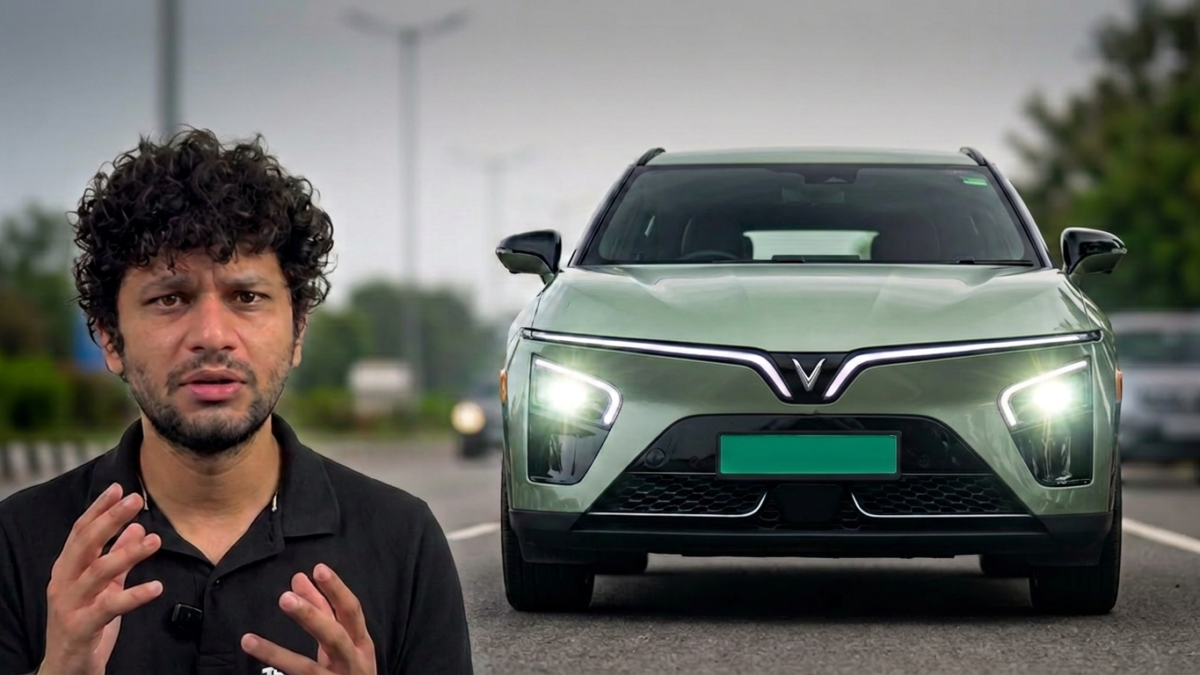
The VinFast VF7 Sky AWD is one of the most genuinely enjoyable cars I’ve driven this year. 353 PS, 500 Nm, all-wheel drive, properly fast, and a chassis that handles far better than a 2.2-tonne electric SUV has any right to. It’s also 5-star Bharat NCAP rated, locally assembled in Tamil Nadu, and priced at around ₹26 lakh — which by the numbers makes it one of the most compelling EV propositions in India.
And there is a second set of facts a buyer spending that much deserves to see. VinFast’s own auditors have formally flagged a material uncertainty about the company’s ability to continue as a going concern. Its service network in India is young. Its charging network is still building out.
Both of those paragraphs are true at the same time, and pretending otherwise would be doing you a disservice. This review is about how to hold both — what makes the VF7 a genuinely good car, what the risks actually are in practical terms, and the specific test that tells you whether you’re the buyer who should go ahead.
There’s also one pre-delivery check on this car that matters more than on almost anything else we’ve reviewed. If the VF7 is on your list, the VinFast PDI Master Blueprint covers it, and we’ll come to exactly why it’s the one you cannot skip.
The drive — this is a properly quick car
Start with what the VF7 Sky AWD does brilliantly. The dual-motor all-wheel-drive setup produces 353 PS and 500 Nm, and it deploys it with the instant, seamless shove that makes performance EVs so addictive. This car is properly fast in a way that will surprise anyone stepping out of a comparably priced petrol SUV.
What impressed more is the handling. At around 2.2 tonnes this is a heavy machine, and physics doesn’t negotiate — you feel the mass in direction changes. But the VF7 stays composed, planted, and confident through corners in a way that suggests real chassis engineering rather than a battery bolted into a body. The ride is on the firm side for broken city roads, settling into something mature and European-feeling once you’re up to speed on a highway.
It’s a blast to drive. That’s the honest headline, and everything else in this review is context around it.
Battery, range and the LFP decision
The VF7 uses LFP (lithium iron phosphate) chemistry, and that’s a genuinely good call for Indian conditions. LFP packs tolerate being charged to 100% routinely, which NMC chemistry doesn’t, and they typically offer better cycle longevity and thermal stability. The trade-off is slightly lower energy density, meaning marginally less range for a given pack size. For a car that will live in Indian heat and get charged daily, that’s a trade worth making.
On range, be realistic. Against a claimed figure in the 510–530 km band, expect roughly 400 km in genuine mixed real-world conditions. That’s not a scandal — it’s the normal gap between test-cycle figures and reality, and 400 km is perfectly usable. But plan your ownership around 400, not 510, and you’ll never be caught out.
VinFast currently offers free charging until March 2029 through its V-Green network, which is a meaningful ownership saving. The caveat is coverage: the network is still limited, and its usefulness depends entirely on whether it reaches where you actually drive. Check the map for your routes before you let this influence your decision.
Cabin, space and the quality question
The interior is minimalist and modern — vegan leather, a clean dashboard, and a heads-up display doing work that a conventional instrument cluster would otherwise handle. The seats are comfortable, the cabin is roomy, and with a 2,840 mm wheelbase the rear offers around 7.5 inches of legroom. The coupe-influenced roofline does eat into rear headroom for taller passengers, so sit in the back yourself before deciding.
Wireless charging, multiple USB ports, and the rest of the expected kit are present. The panoramic glass roof on this trim is a fixed panel rather than the full “infinity” glass of the Infinity variants.
Now the honest part. The touchscreen interface shows a slight lag, and the minimalist dashboard means more functions live inside it than some drivers will like. Visibility is compromised by notable blind spots. Panel gaps are inconsistent enough to notice — not catastrophic, but not the tight, uniform finish a ₹26 lakh car should deliver. And there are reports of interior trim pieces failing under thermal stress, which in Indian summer parking conditions is not a theoretical concern.
None of these make the VF7 a bad car. They do mean this is a car where the specific unit you’re handed matters, and where a careful inspection before payment is worth real money.
Safety — a genuine 5-star
This deserves its own section because it’s unambiguously strong. The VF7 holds a 5-star Bharat NCAP rating for both adult and child occupant protection. Seven airbags come as standard across the range, along with a 360-degree camera and a Level-2 ADAS suite.
For a new entrant that some buyers will instinctively question on safety grounds, this is about as emphatic an answer as the Indian testing regime can give. The VF7 is a safe car, and that’s not a marketing claim — it’s a tested result.
The company question — the facts, without the drama
Here is where a buyer-first review has to be precise rather than sensational.
VinFast’s audited accounts carry a formal “material uncertainty related to going concern” paragraph. The auditors noted a substantial net loss for the year ended December 2025 and current liabilities significantly exceeding current assets. Importantly, the auditors’ opinion was not modified in respect of this matter — the accounts were signed off, with this flagged as an emphasis. Quarterly results through 2026 have shown revenue and deliveries growing while losses continued to widen.
What does that actually mean for you, practically? It does not mean the company is closing tomorrow. It does mean VinFast’s continued operation depends on ongoing funding, and that is a risk sitting outside your control for the life of your ownership. For a phone or a laptop, that risk is trivial. For a ₹26 lakh vehicle whose software, parts, warranty and battery support all depend on the manufacturer continuing to exist in your market, it is a real input to the decision.
The strongest counterweight is that VinFast is not treating India as a toe-dip. The VF7 is locally assembled in Tamil Nadu, and the company has been expanding its dealership footprint across the country. Local assembly represents genuine committed capital, and it is the single most encouraging signal for a prospective Indian buyer.
The honest state of play on service: the network is young. After-sales capability, parts availability and turnaround times are still being proven. That is not a criticism of intent — it’s the reality of a new brand at an early stage, and it should shape how you buy rather than whether you buy.
Our verdict — the three-condition test
We don’t hedge on recommendations, so here it is plainly. Buy the VinFast VF7 if, and only if, all three of these are true for you:
One: there is a VinFast service centre within practical reach of where you live. Not “coming soon” — operational today. With a young network, distance to service is the difference between a minor issue and a fortnight without your car.
Two: you can charge at home. The free V-Green charging until 2029 is a bonus, not a foundation. If your daily charging depends on a public network that’s still building out, you’re taking on a second risk on top of the first.
Three: this is not your only car. This is the condition most buyers will be tempted to wave away, and it’s the one that matters most. A household with a second vehicle absorbs a long service turnaround as an inconvenience. A single-car household absorbs it as a crisis.
Clear all three and the VF7 is a genuinely excellent buy — a fast, safe, well-engineered EV at a price its established rivals can’t match. Fail any one of them, and the risk profile stops making sense regardless of how good the car is. That’s not us being cautious for the sake of it; it’s the same arithmetic we’d apply to our own money.
The one PDI check you cannot skip on this car
Every car we review gets a pre-delivery inspection recommendation. On the VF7, one specific check stands above everything else, and it’s one almost no buyer knows to perform.
Match the battery pack identifier to the vehicle VIN, and verify both against your paperwork. On an EV, the battery pack carries its own identity separate from the car’s VIN. Cross-checking that they correspond — and that both match what your invoice and registration documents say — is the single most important verification on an electric vehicle, and it takes two minutes if you know where to look.
Why it matters more here: with a new brand, limited stock and pressure to deliver, showroom display cars and demonstrator units entering the delivery pipeline as new is a known risk across the industry. A car that has spent months on a showroom floor, being started, cycled, sat in, and occasionally driven, is not the same as a car that came straight off the line — and on an EV, the battery is where that history quietly accumulates. Check the odometer. Check the manufacturing date. Check the battery identifier. Ask for a battery health report and get it in writing before payment.
Alongside that, this car’s specific inspection priorities are clear: walk every panel gap in daylight and photograph the inconsistent ones, examine interior trim pieces closely for stress marks or poor seating, test every function inside the touchscreen individually rather than assuming the screen lighting up means the system works, verify the 360-degree camera stitches cleanly, and confirm every ADAS function engages on a test drive.
The full VinFast inspection sequence — battery health verification, VIN and pack matching, EV-specific checkpoints, and photo references for what each issue actually looks like — is in the VinFast PDI Master Blueprint. 70+ checkpoints, ₹1,499 once, no dealership sponsorship, no upsells. More than 1,200 buyers have used our blueprints to take delivery knowing exactly what they were signing for. On a car from a young brand at this price, walking in with that certainty is worth considerably more than the inspection costs.
The closing call
The VinFast VF7 Sky AWD is a properly good car. It’s quick, it handles, it’s genuinely safe, it’s well equipped, and it undercuts established rivals on price. If you drove it without knowing the badge, you’d be impressed — I was.
What you’re buying alongside it is a manufacturer whose financial position carries documented uncertainty and whose Indian support infrastructure is still maturing. That’s not a reason to write the car off. It’s a reason to apply the three-condition test honestly, and to walk into your delivery appointment having verified everything yourself — starting with that battery identifier.
Buy it for the right reasons, under the right conditions, with your eyes open. Then inspect it properly, because on this car more than most, knowing exactly what you’ve been handed is the whole game. The dealer won’t do that for you. The PDI comes first.