- Want a car with genuine character — the exhaust note and steering feel are why people keep these forever
- Enjoy driving — the firm chassis and 1.0 GDI make this the engine's best application in the range
- Plan to modify — the aftermarket and tuning support for this car is genuinely brilliant
- Need rear space in a sporty car — it's roomier at the back than the Skoda Kylaq
- Want one car that does both — Eco mode for the commute, Sport mode for the weekend
- Want a soft, cushy ride — the suspension is deliberately firm and you feel the road
- Regularly drive fully loaded over tall breakers — it will scrape the underbelly
- Want hard launches from the DCT — the software manages standing starts, it won't let you launch
- Expect flawless cabin plastics — it's a mix of soft-touch and hard, with rear finishing that could be better
- Buy purely on rational value — this is a character purchase and it should be
Some cars are transport. You buy them, you use them, you sell them, you barely think about them again. The Hyundai i20 N Line is not one of those cars. It’s one of the rare ones people buy and then simply never let go of, the car that sits in the garage years longer than the spreadsheet says it should, because selling it feels like losing something. That’s a strange thing to say about a hatchback. It’s also the truest thing about this one.
We drove the N8 DCT, and this review is about what makes the i20 N Line a car with genuine character rather than just a warm hatch with red accents. It’s also about the specific, real faults our own PDI customers have found on this car — because a car people keep forever is a car worth inspecting properly before you commit.
If the i20 N Line is on your shortlist, the Hyundai PDI Master Blueprint is the inspection guide we’d want before any Hyundai delivery — and on this model specifically, there are two checks our customers have already proven matter.
That exhaust note — the thing you’ll remember
Start the i20 N Line and the twin exhaust tips deliver a genuinely fruity, characterful note. It’s sportier and raspier than the Creta N Line, and it’s the single detail that tells you this car was tuned by people who cared about how it sounds, not just how it measures. In a segment where most cars aim for silence, the i20 N Line deliberately gives you something to enjoy.
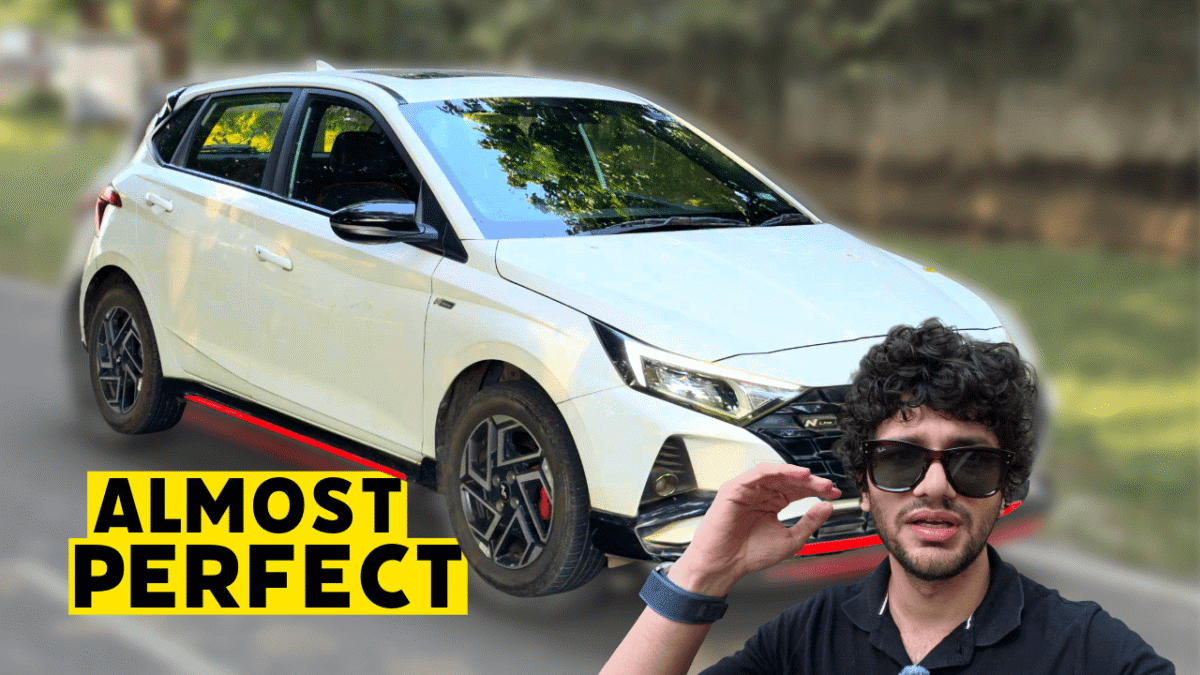
The rest of the styling backs up the promise. Sharp DRL treatment, red accents, blacked-out trim, N Line badging, 195/55 R16 alloys, and a stylistic rear spoiler. It’s aggressive without being a costume — the car looks like what it is rather than pretending to be something faster.
The 1.0 GDI — this is the engine’s best home
Hyundai’s 1.0-litre three-cylinder GDI turbo makes 120 PS and 172 Nm, and it appears in several cars in the group’s range. This is where it works best. In the lighter i20 body, with the N Line’s chassis tuning behind it, the engine finally has a car worthy of it. It feels eager, willing, and genuinely quick in a way it doesn’t always manage elsewhere.
The dual-personality setup is well judged. In Eco mode it’s a calm, efficient daily commuter. Switch to Sport and the throttle sharpens, the exhaust wakes up, and the whole car changes character. That flexibility is a big part of why this works as an only-car for an enthusiast rather than a weekend toy.
The engine bay is neat with good underbody protection, though it lacks dedicated insulation — which is part of why you hear as much of the engine and exhaust as you do. In this car, that’s a feature, not a fault.
DCT or manual? The honest answer
The DCT with paddle shifters is engaging and makes the car properly fun to drive quickly. Acceleration is brisk once you’re moving, and rowing through gears on the paddles is genuinely satisfying. But there’s an honest caveat: the DCT won’t let you launch the car. Ask for an aggressive standing start and the software steps in — you get a controlled, managed getaway rather than the hard launch the engine could deliver. DCT is also slower than DSG in shift times.
The manual is more fun. If driver involvement is why you’re buying an i20 N Line — and for most buyers of this car, it is — the manual gives you more of exactly the thing you came for. The DCT is the right pick if you’re in heavy traffic daily and want convenience without giving up all the character. Choose honestly based on your commute, not on what sounds sportier.
The cabin, the Bose, and that steering wheel
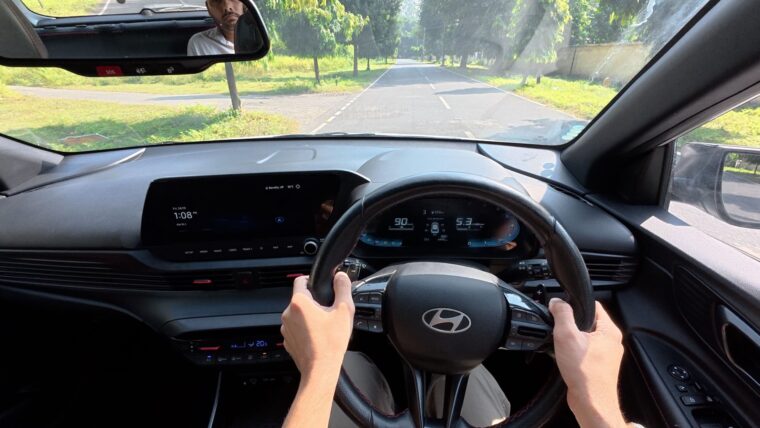
The all-black cabin with black roof liner sets the right tone. The perforated steering wheel is a genuine highlight — it’s lovely to hold, well weighted in the hand, and it’s the contact point you’ll appreciate every single drive. The N-branded gear lever and sporty pedals continue the theme, and the leathered seats with N Line embossing look properly special.
The Bose sound system deserves specific praise: it’s very good, well beyond what the segment usually offers, and on a car built around enjoying the drive, having audio worth listening to matters. Practical kit is solid too — Highline TPMS as standard, wireless charging, rear AC vents, USB-A and USB-C ports, an electrochromatic IRVM, and a height-adjustable driver’s seat.
Honest note on quality: it’s a mix of soft-touch and hard plastics, and the rear finishing could be better. The cabin feels classy overall, but it’s not flawless, and pretending otherwise would be doing you a disservice.
Space — and how it compares to the Kylaq
Here’s something buyers get wrong about the i20 N Line: they assume a sporty hatch means cramped. It doesn’t. The rear bench offers decent headroom and legroom, and the floor hump is minimal compared to rivals, which makes the middle seat genuinely more usable.
Specifically — and this surprises people — the i20 N Line is more spacious at the rear than the Skoda Kylaq. If you’re cross-shopping between the two, and many buyers in this price range are, that’s a real point in the i20’s favour. For a fuller picture of the alternative, our Skoda Kylaq Prestige review covers the sub-4m SUV case in detail. The choice comes down to whether you want SUV stance or hot-hatch character; the i20 N Line wins on rear space and on driving joy.
The boot is decent, fitting two large bags, with a handle for closing that’s a small but appreciated touch.
Ride, handling, and the underbelly warning
The suspension is firm. That firmness is deliberate and it’s what gives the car excellent confidence in corners — this is a hatch that genuinely enjoys being driven hard, and the chassis rewards you for it. Around town, you feel more of the road than you would in a softer rival. That’s the trade, and for the buyer this car is aimed at, it’s the right one.
One practical warning worth knowing before you buy: when fully loaded with passengers and luggage, the i20 N Line will scrape its underbelly on steeper ramps, tall speed breakers, and rough entries. It’s a low car and that’s part of the appeal, but plan for it — approach steep entries at an angle and take tall breakers slowly, especially with a full car.
The aftermarket and tuning story
Something that separates the i20 N Line from most cars in its class: the aftermarket and tuning support is brilliant. There’s a genuine ecosystem around this car — mapping, exhausts, suspension, cosmetic upgrades — and a community that’s actively developing for it.
That matters more than it might sound. It means the car can grow with you rather than staying static, and it’s a big part of why owners form the attachment they do. You’re not just buying a finished product; you’re buying a platform you can make yours over years of ownership.
What our PDI customers actually found on this car
This section isn’t based on forum speculation. These are faults that buyers using our PDI Master Blueprint have identified on i20 N Line units during their own pre-delivery inspections, and they’re the two things we’d tell any i20 N Line buyer to check first.
Rusted hinges. Customers have found corrosion on hinges — the kind of early rust that appears on units which have sat in stockyards, particularly in humid conditions. Open the bonnet, the boot, and all four doors, and inspect every hinge, along with the surrounding joints and seams. This is a hidden area buyers almost never think to check because they’re looking at painted surfaces, and it’s exactly where corrosion starts on a car you intend to keep for a decade.
Weak cooling. Customers have also flagged cooling performance issues in the used cars. On a turbocharged car — one that many owners will drive enthusiastically and some will eventually tune — the cooling system doing its job properly is not optional. When inspecting an used i20 N Line during PDI, run the AC at full and confirm it cools fast and holds; check the coolant level and condition; and inspect the cooling pack behind the grille for damage or debris.
These aren’t hypothetical risks — they’re documented findings from buyers who inspected before paying and had leverage as a result. The full inspection sequence for the i20 N Line, with photo references for what each issue looks like and dealer-deflection scripts for when the salesperson tries to wave you off, is in the Hyundai PDI Master Blueprint. 70+ checkpoints, ₹1,499 once, no dealership sponsorship, no upsells. On a car you plan to keep forever, catching rust and cooling problems on day one is worth considerably more than the inspection costs.
And for the first 1,500 km, run this turbo engine in properly — it matters more on a forced-induction car that will spend its life being enjoyed, which is what the Engine Break-In Blueprint at ₹999 is built around.
The closing call
The Hyundai i20 N Line is a car with character in a market that produces fewer of them every year. The exhaust note, the steering wheel, the eager little GDI in its best application, the firm chassis that rewards commitment, the Bose system, and an aftermarket scene that lets you make it yours — these add up to something more than the spec sheet explains.
It’s a car people buy and then find they can’t part with. That’s the highest compliment you can pay a hatchback, and it’s the honest reason to buy this one. Just inspect it properly first — check those hinges, check the cooling — because if you’re going to keep a car forever, you want to start with a good one. The dealer won’t check for you. The PDI comes first.