- Run high monthly mileage — 12+ kmpl in tier 2 city and 20+ kmpl highway is exceptional for a petrol SUV this size
- Plan to keep the car a decade — the K15C plus Smart Hybrid is built for cheap, reliable long-term running
- Want to modify — the Sigma is the best blank canvas in the range to build exactly the car you want
- Value real safety kit on the base car — four-wheel disc brakes even on Sigma
- Trust Maruti's service reach and low ownership costs over a rival's feature list
- Carry adults in the back on long highway runs regularly — rear comfort trails the sedans buyers trade out of
- Want features out of the box — the Sigma is deliberately sparse and expects you to add what you need
- Need outright performance — 105 PS tuned for efficiency, not excitement
- Expect a soft, plush ride — the suspension is firm-but-planted, not cushy
- Want alloys, LEDs, and a big screen as standard — those are higher trims or aftermarket on the Sigma
Almost every Grand Vitara review you’ll find is of the top Alpha+ trim — loaded, dual-tone, all-wheel-drive in some cases, priced where the headlines are. This isn’t that. We’re reviewing the Sigma, the base variant, because that’s the one a huge share of real buyers actually drive home. The question that matters isn’t “how good is the most expensive Grand Vitara.” It’s “how much car do you actually get when you buy the one most people can afford?”
The answer, it turns out, is “more than you’d expect” — with a few honest caveats the brochure won’t spell out. We drove the Sigma manual, and then we did something most reviews don’t: we sat down with an actual owner, Vidit, who bought his and lives with it daily. Part of what makes this review worth your time is that second voice.
If the Grand Vitara is on your shortlist, the Maruti Suzuki PDI Master Blueprint is the inspection guide we’d want before any Maruti delivery — and on this car, there are two specific checks that catch the issues Grand Vitara buyers most often discover too late. More on those below.
The base variant that doesn’t feel basic
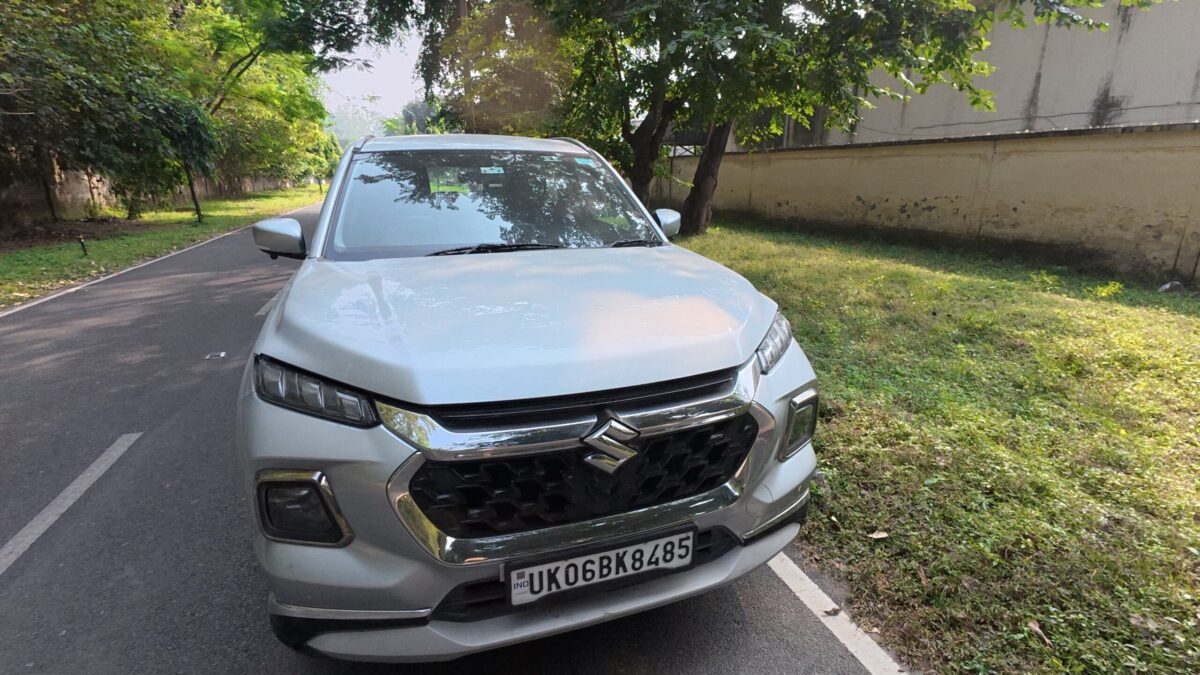
The Sigma rolls on 17-inch steel wheels with covers. Purists (and our reviewer) actually prefer the look of the naked black steelies underneath, and they’re cheaper to live with than alloys if you scuff one. The car we drove had a few owner-added touches — LED headlamps in place of the stock halogens, a 360-degree camera — but those are aftermarket, not Sigma equipment, and we’re judging the variant on what it ships with.
What genuinely surprises about the Sigma is how much real equipment survives the cost-cutting. You still get engine start/stop, auto climate control, and a sliding armrest. You still get four-wheel disc brakes — discs at the rear, not drums, even on the base car, which is a real safety point most rivals reserve for higher trims. And the Sigma we drove had a full-size spare tyre, not the puncture repair kit that newer stock units are increasingly shipping with. If a full-size spare matters to you, confirm it’s present on the exact unit you’re buying, because that spec has been quietly changing.
The 1.5 K15C + Smart Hybrid — built for the long haul
The car we drove runs Maruti’s 1.5-litre K15C four-cylinder petrol with the Smart Hybrid mild-hybrid system — roughly 105 PS and 140 Nm. This isn’t a powertrain that chases excitement. It’s one built for two decades of cheap, reliable running, and on that brief it’s close to unbeatable.
Open the bonnet and the engine bay is unusually tidy for the price — well-insulated, clearly organised, with legible markings for the maintenance fluids. There’s proper under-body protection for the engine, which our reviewer rated highly and which matters more than buyers realise on Indian roads, where a stray rock or a flooded underpass can do expensive damage to an unprotected sump.
The mild-hybrid system is the quiet efficiency story. It won’t drive the car on electric power — that’s not what mild-hybrid does — but the integrated starter-generator smooths the start/stop cycle and trims fuel use in stop-go traffic. The payoff shows up in the numbers below, and they’re the real reason this engine exists.
Real-world mileage — the number that sells this car
This is where the Grand Vitara Sigma makes its strongest rational case. During our drive, the car showed figures up to 22.5 kmpl on a steady cruise. Vidit, the owner we interviewed, reports a consistent 16–17 kmpl in city traffic and up to 24 kmpl on the highway in his daily use.
Those are owner-real numbers, not ARAI-lab fantasies, and they’re exceptional for a petrol SUV of this size. For a high-running buyer — and the Grand Vitara attracts a lot of them — this efficiency is frequently the entire reason the car gets bought over a thirstier rival.
How it drives — Japanese easy, not exciting
The Sigma manual is the definition of an easy car to drive. The clutch is light, the gearshift is smooth and slick in classic Maruti fashion, and there’s nothing here that asks anything of you. It’s effortless in traffic, which is exactly what its buyer wants.
The suspension strikes a balance our reviewer rated as firm yet planted — it doesn’t wallow, it doesn’t crash, and it stays composed at the speeds this car actually travels. It’s not a back-road weapon and it never pretends to be. The K15C is refined low down and only gets vocal when you push it hard, which in this car you rarely will.
One genuinely nice touch on the practicality front: the rear seat is spacious for the segment and gets an adjustable recline angle, which makes a real difference on long drives — a feature even some pricier rivals skip.
The owner’s verdict — why Vidit chose it over a Creta
Here’s where this review earns its keep. Vidit is a lawyer, a long-time Maruti loyalist, and he bought his Grand Vitara Sigma over the obvious segment leader — the Hyundai Creta — for reasons that tell you a lot about who this car is really for.
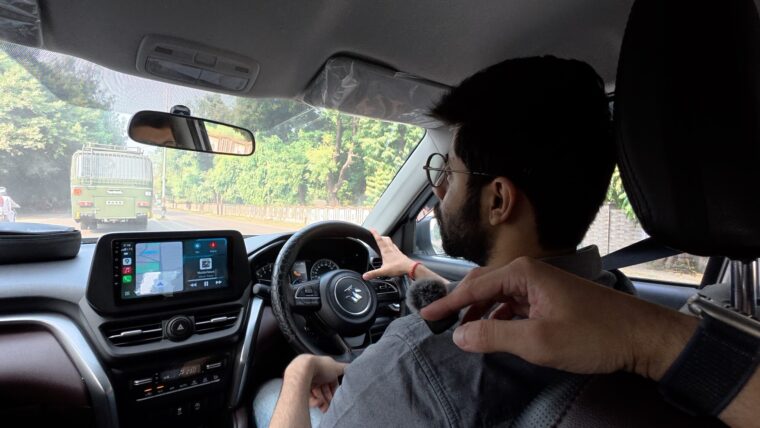
His logic was unsentimental: trust in the brand, superior fuel economy, and lower ownership costs over the life of the car. He’d also done his homework on the used market and found that a Creta with comparable features at the same price point was simply hard to find. He bought a 2024 Sigma from Maruti True Value with 17,000 km on it for ₹9 lakh — a unit whose previous owner had already fitted a 360-degree camera, a touchscreen with Android Auto and CarPlay, and LED lighting. By his own account, a fantastic deal once you priced in the modifications.
Vidit moved to the Grand Vitara from a Ciaz — an automatic sedan — and he’s honest about the trade-off. He loves the higher SUV seating and finds it more convenient and enjoyable in city traffic, and he says he’s unlikely to go back to a sedan. But he concedes the Ciaz had better back-seat comfort and a better recline angle for long journeys. That’s the one area where the Grand Vitara asked him to compromise, and it’s worth knowing if your family spends real time in the back on highways.
He also explained why he skipped a Brezza ZXI for the Grand Vitara: coming from a Ciaz, a Brezza would have felt like a downgrade in space and presence. He wanted a clear step up into the segment, not a sideways move. That framing — “I wanted an upgrade, not a lateral shift” — is exactly the buyer the Grand Vitara is built to win.
What you should check before delivery — and why it matters more here
The Grand Vitara is a genuinely well-built car, but there are two specific pre-delivery issues that Maruti buyers report often enough that they’re worth singling out — and both are things a dealer will not volunteer.
The first is dealer washing. As our reviewer flagged in the video, the high-pressure wash settings used at many dealerships can bend or damage the radiator fins behind the front grille. It’s invisible to most buyers and the kind of damage you only discover later when cooling performance suffers. At PDI, the cooling pack behind the grille should be inspected, and you should explicitly tell the dealer not to high-pressure wash the front.
The second is paint and panel inspection along the lower doors. New Maruti Suzuki cars sometimes arrive with scratches along the lower portion of the doors — from stockyard handling, transport straps, or tight parking during pre-delivery storage. This is precisely the area buyers don’t think to check because they’re looking at the showroom-polished upper panels. At PDI, inspect the lower third of every door in daylight, after a wash.
These aren’t paranoid concerns — they’re the specific patterns we’ve seen repeated across Maruti deliveries. The full pre-delivery sequence for the Grand Vitara, with photo references for what each issue actually looks like and dealer-deflection scripts for when the SA tries to wave you off, is in the Maruti Suzuki PDI Master Blueprint. 70+ checkpoints, ₹1,499 once, no dealership sponsorship, no upsells. And if you’re buying used like Vidit did, a PDI matters even more — there’s no factory warranty cushioning whatever the previous owner and the dealership didn’t disclose.
The blank-canvas appeal
One last thing that makes the Sigma quietly clever: it’s the best Grand Vitara to modify. Because you start cheap and unburdened by features you’d be paying to replace, the base variant is a blank canvas. The car we drove had already been upgraded with LED headlamps, a 360 camera, a custom head unit, and a steering wheel sourced from a higher variant — the latter oddly fitted with functional paddle shifters on a car with a 5-speed manual, which is the kind of harmless quirk that makes a modified base car fun.
Start with the Sigma, add only what you actually want, and you can build a car that suits you exactly — often for less than the cost of climbing the variant ladder for features you’d never use. For the first 1,500 km, treat the engine gently; this naturally aspirated unit rewards a proper running-in, which is what the Engine Break-In Blueprint at ₹999 is built around.
The closing call
The Maruti Suzuki Grand Vitara Sigma is the rational person’s SUV. It’s not the fastest, it’s not the most feature-loaded, and the rear-seat comfort gives a little ground to the sedans some buyers trade out of. But it’s superbly efficient, genuinely well-built, cheap to run for years, backed by the widest service network in the country, and — as a base variant — it leaves you money and freedom to make it yours.
For a buyer who values low running costs and long-term reliability over outright features, this is one of the smartest buys in the segment. Just inspect it properly before you take delivery — new or used. The dealer won’t. The PDI comes first.