
- Can charge at home and drive mostly in the city: the Tomahawk PHEV claims over 115 km on electricity alone
- Want the cheapest hybrid seven-seater here: the Hycross GX Hybrid is ₹23.99 lakh
- Need luggage space with all seven seats in use: the Hycross offers around 300 litres
- Want the most power and the longest range per tank: the Sorento has a 67-litre tank
- Want ventilated seats, a panoramic sunroof and a 360 camera: only the Tomahawk Exclusive has all three
- Cannot charge where you park: the Tomahawk's main advantage depends on plugging in
- Travel with seven people and luggage often: the Tomahawk and Sorento offer under 200 litres with all rows up
- Want wireless phone projection and cruise control on a budget: the Hycross GX Hybrid has neither
- Want front parking sensors on the Tomahawk: it relies on the 360 camera instead
- Expect the Sorento HTE to include a sunroof: it does not on this variant
India now has three very different ways to buy an electrified seven-seater for between ₹24 lakh and ₹30 lakh. The freshly facelifted Toyota Innova Hycross is a self-charging strong hybrid. The MG Hector Tomahawk PHEV is a plug-in hybrid you can charge like an electric car. The Kia Sorento pairs a turbo-petrol engine with a strong-hybrid system. On a spec sheet they look like direct rivals, but underneath they work in completely different ways, and that difference will shape your running costs more than any single number in a brochure.
This comparison puts them side by side on price, powertrain, space and equipment, using three specific seven-seat variants: the Hycross GX Hybrid, the Tomahawk Exclusive PHEV and the Sorento HTE Hybrid. All prices are ex-showroom. Electric range, charging time and efficiency figures are manufacturer claims.
If you are weighing up electrified seven-seaters for the first time, the most useful question to answer before reading on is a simple one: can you charge a car where you park it every night?
Self-charging hybrid or plug-in: the difference that matters most
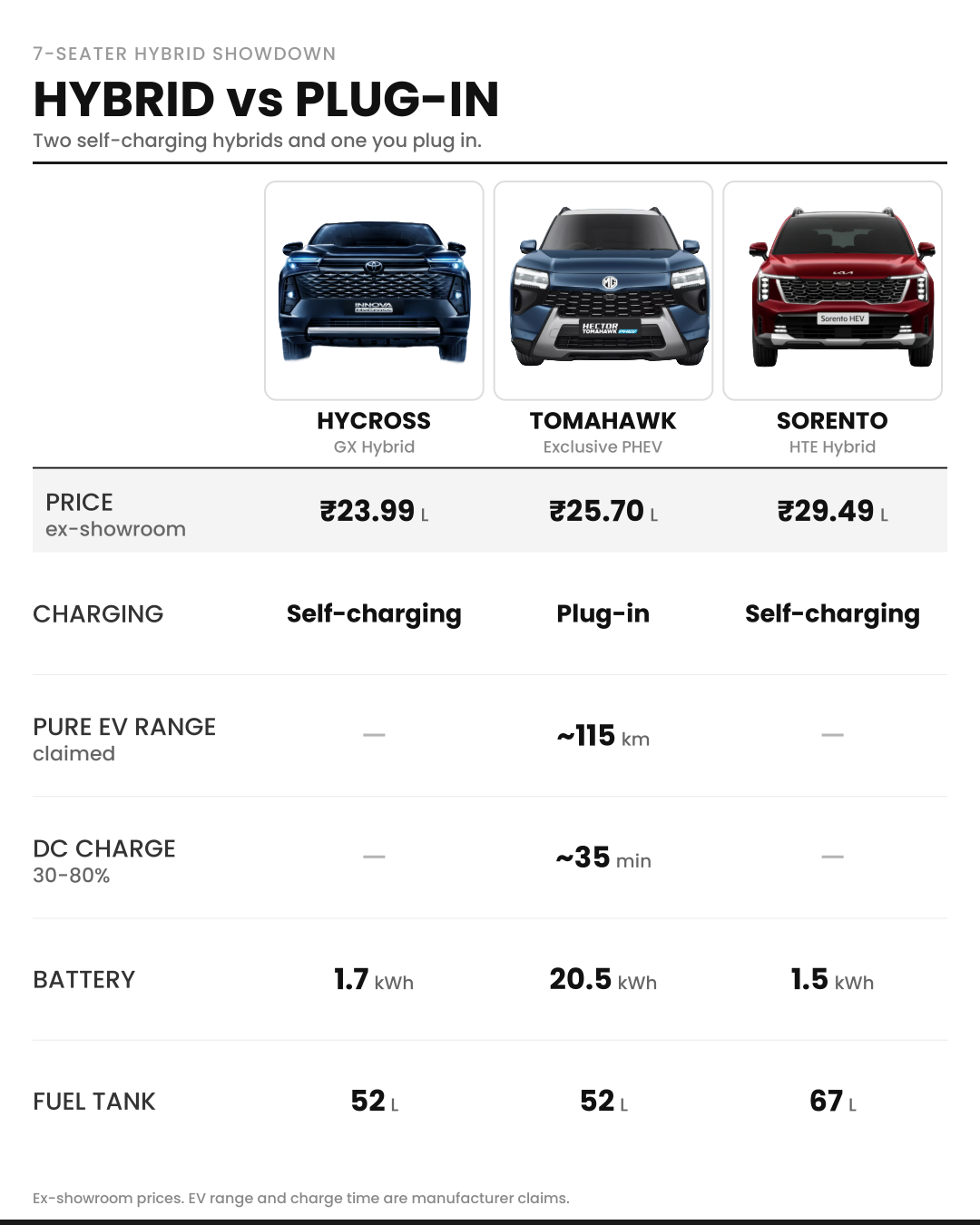
The Hycross and the Sorento are self-charging hybrids. Each carries a small battery, 1.7 kWh in the Hycross and 1.5 kWh in the Sorento, which is topped up by the engine and by regenerative braking. You never plug them in. The electric motor assists the engine, lets the car creep and cruise on electric power for short stretches, and recovers energy you would otherwise lose as heat in the brakes.
The Tomahawk PHEV works differently. Its 20.5 kWh battery is more than ten times larger, and it has a CCS2 charging port. MG claims a pure-electric range of over 115 km, and a DC charge from 30 to 80 percent in around 35 minutes. On a 3.3 kW AC home charger, a full charge takes around seven and a half hours, which suits overnight charging.
Fuel tanks are 52 litres in both the Hycross and the Tomahawk, and 67 litres in the Sorento, which gives the Kia the most distance between fuel stops on paper.
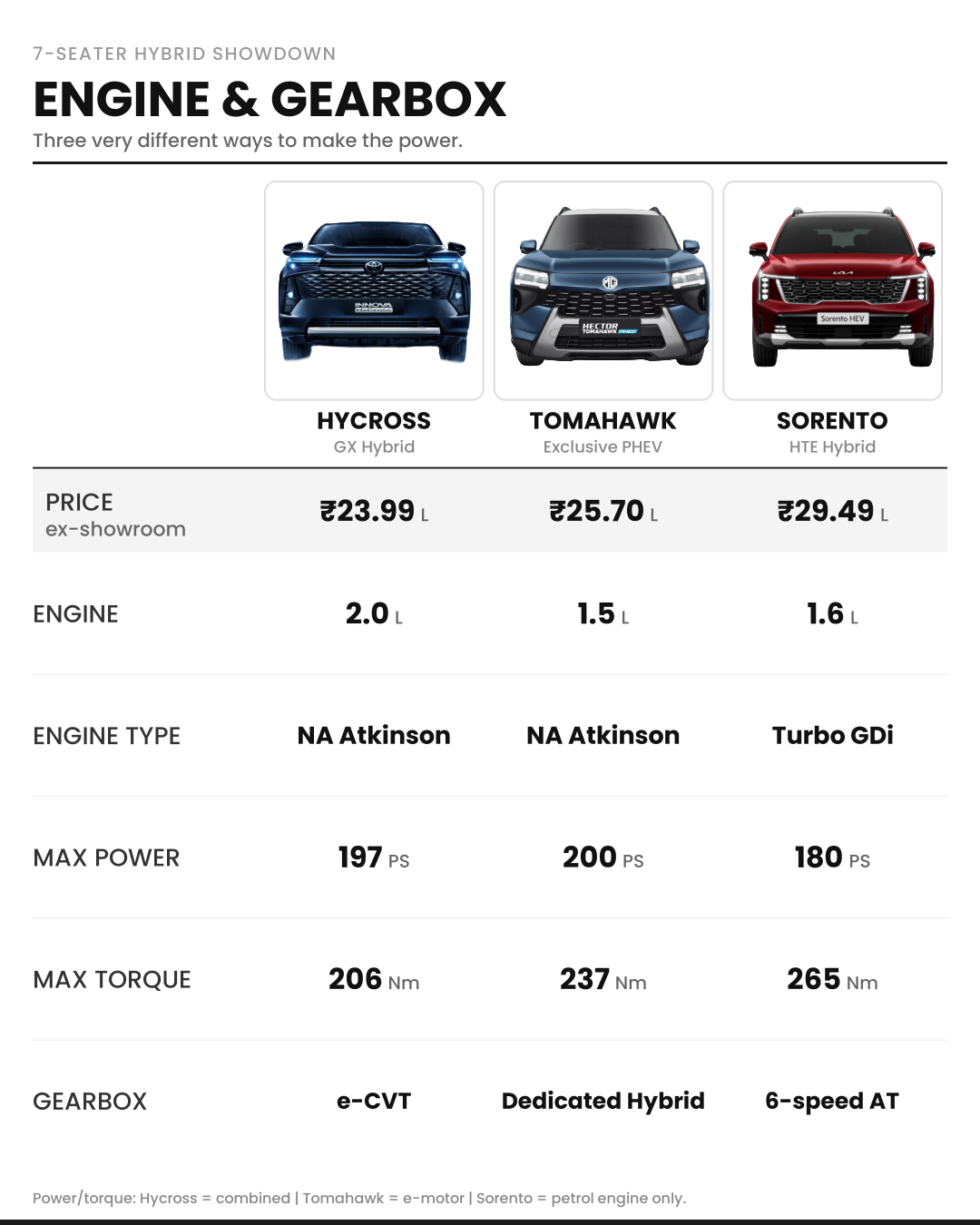
Engines and gearboxes
The Hycross uses a 2.0-litre naturally aspirated Atkinson-cycle petrol engine with an e-CVT, producing a combined output of around 197 hp. The facelift also makes it compatible with ethanol blends up to E85, which makes it India’s first flex-fuel strong hybrid on sale.
The Tomahawk pairs a 1.5-litre naturally aspirated Atkinson-cycle engine, rated at 102 PS and 125 Nm, with an electric motor rated at 201 PS and 237 Nm, through a Dedicated Hybrid Transmission. Combined system output is quoted at 198 hp and 230 Nm.
The Sorento is the only strong hybrid in India built around a turbo-petrol engine. Its 1.6-litre turbo GDi produces 180 PS and 265 Nm on its own, with an electric motor adding to that and a conventional six-speed automatic doing the shifting. Combined output is around 238 bhp, which makes it the most powerful of the three.
One thing to watch when reading spec sheets: the headline power and torque figures for these cars measure different things. The Hycross figure is combined, the Tomahawk figure is the electric motor alone, and the Sorento figure is the petrol engine alone. On combined output, the Hycross and Tomahawk are almost level and the Sorento is clearly ahead.
Which is the most efficient in the city?
For a buyer who can charge at home, the Tomahawk PHEV should be the most efficient of the three in city driving. A claimed 115 km of electric range covers most daily city use, so on a typical day the petrol engine may not need to run at all. When the battery runs low, MG says its Dedicated Hybrid Transmission can operate in a series hybrid mode, where the engine works mainly as a generator and the electric motor drives the wheels, which is an efficient way to handle stop-start traffic. MG claims a combined figure of over 40 kmpl, a number that depends on the battery contributing a large share of the distance.
That advantage depends on plugging in. A Tomahawk that is never charged is a self-charging hybrid carrying a much larger battery around, and the gap to the Hycross narrows. The Hycross remains the established benchmark among self-charging hybrids, and city traffic is where its hybrid system does the most work.
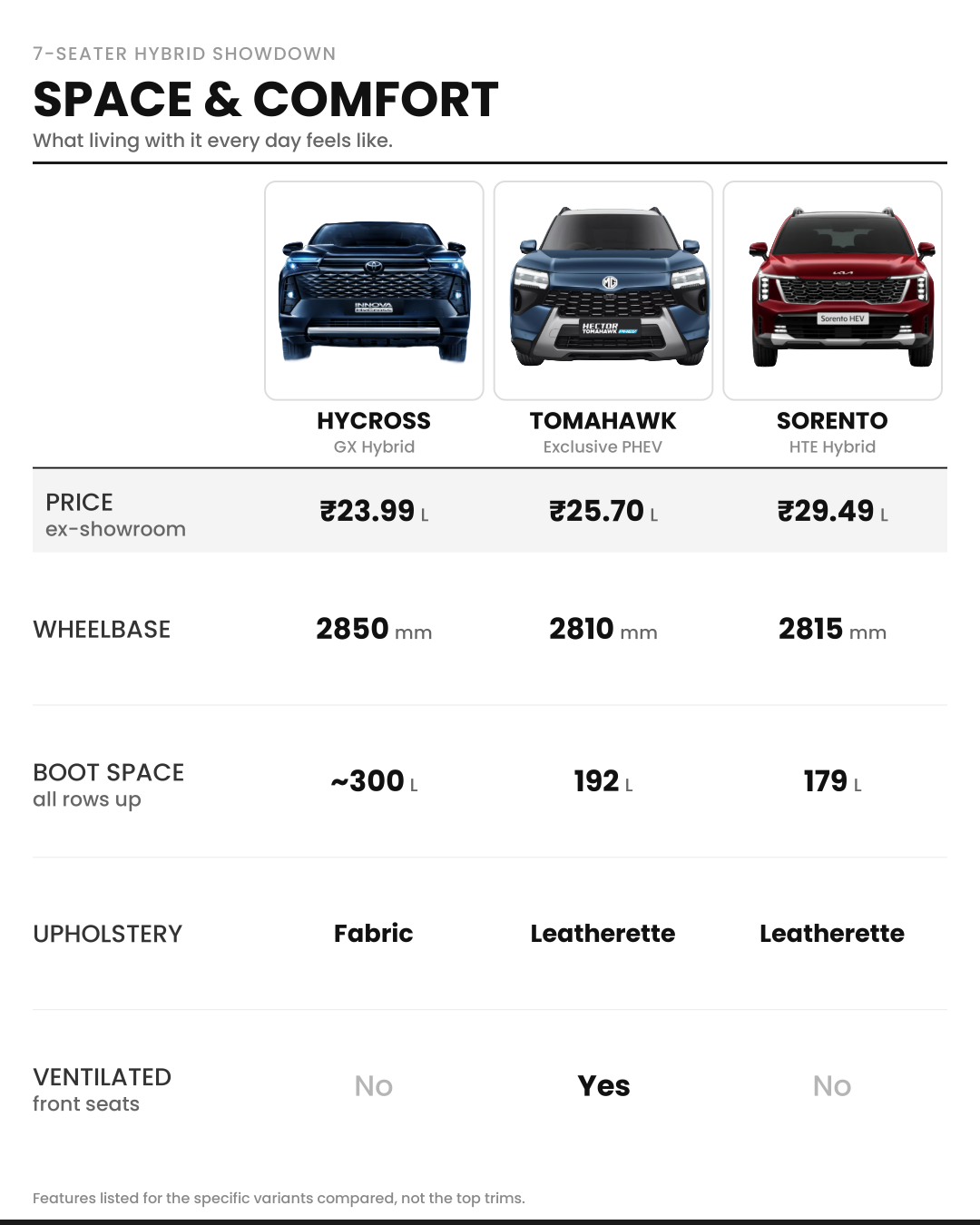
Space and comfort
The Hycross has the longest wheelbase here at 2,850 mm, against 2,810 mm for the Tomahawk and 2,815 mm for the Sorento. The bigger practical difference is luggage space with all three rows in use. The Hycross offers around 300 litres, while the Tomahawk manages 192 litres and the Sorento 179 litres. If you regularly travel with seven people and their bags, that gap matters far more than the wheelbase figures suggest.
On the variants compared, the Hycross GX Hybrid has fabric upholstery, while the Tomahawk and Sorento get leatherette. Only the Tomahawk Exclusive has ventilated front seats, a feature you will use every day in an Indian summer.
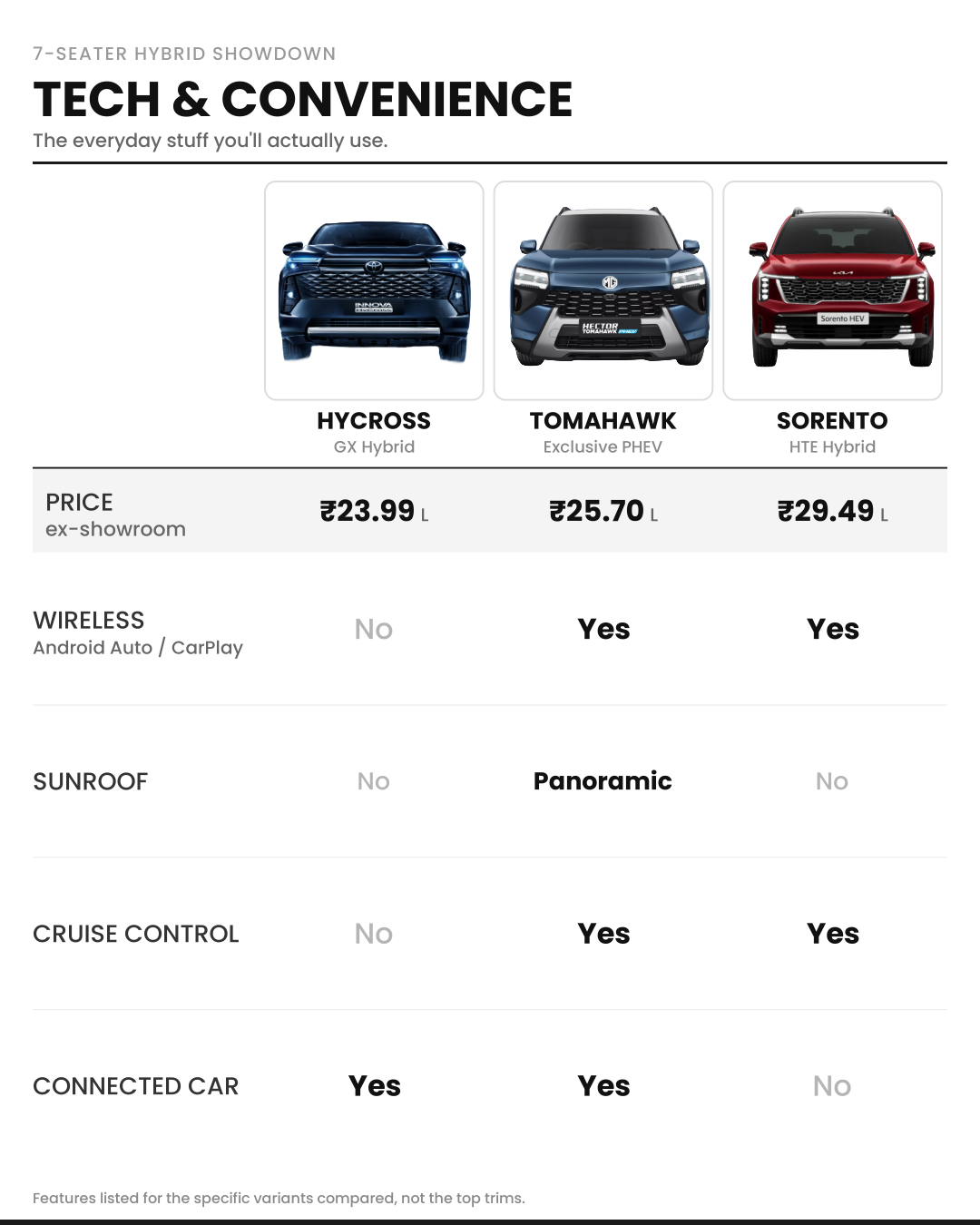
Tech and convenience
The Tomahawk Exclusive is the best equipped of the three variants compared. It gets wireless Android Auto and Apple CarPlay, a panoramic sunroof, cruise control and connected car technology. The Sorento HTE Hybrid has wireless phone projection and cruise control, but no sunroof and no connected car features. The Hycross GX Hybrid has connected car technology but goes without wireless phone projection, a sunroof and cruise control.
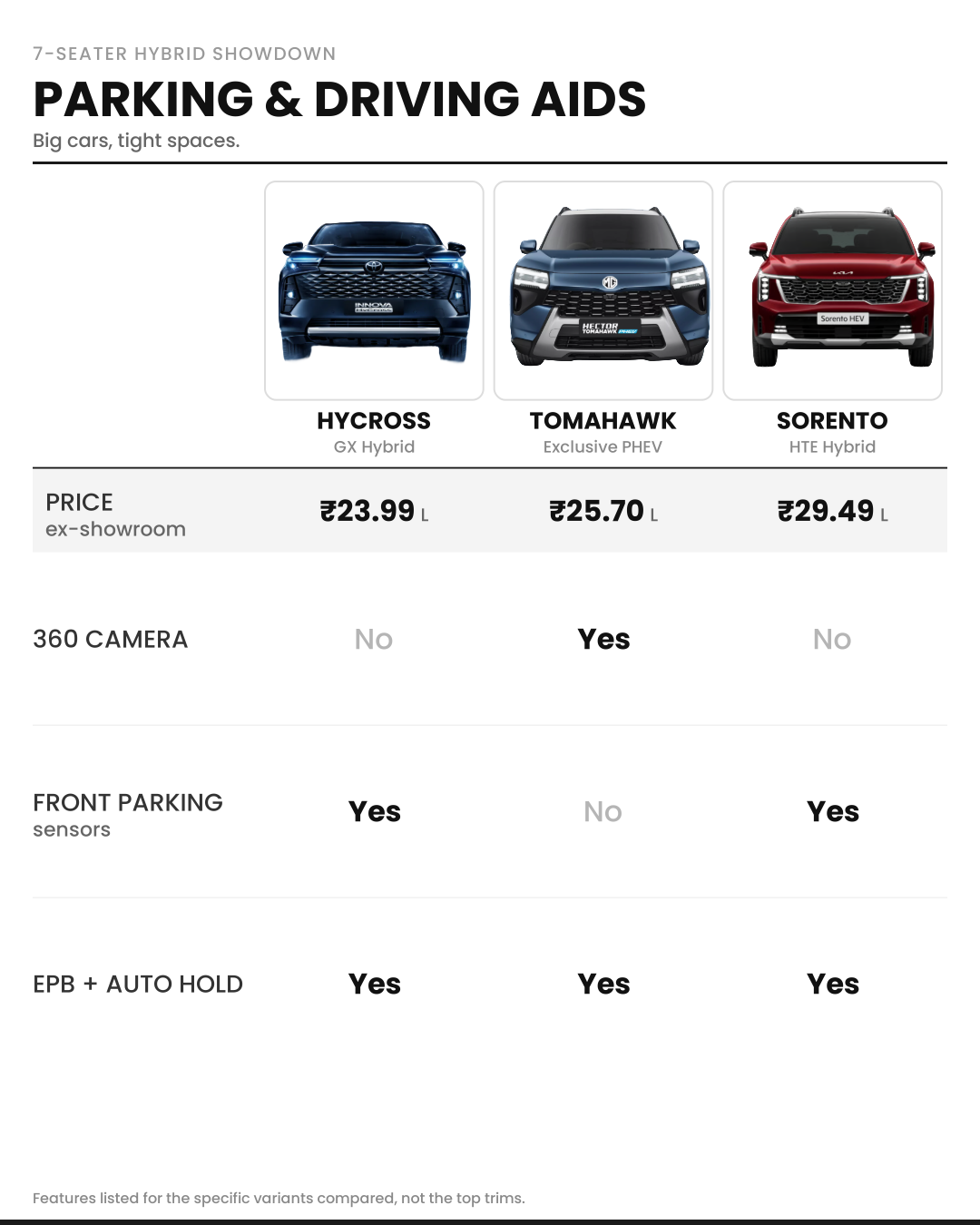
Parking and driving aids
All three get an electronic parking brake with auto hold, which takes the strain out of stop-start traffic. The Tomahawk is the only one of the three with a 360-degree camera, but it does without front parking sensors. The Hycross and Sorento take the opposite approach, with front sensors and no 360 camera. For cars of this size, either setup helps in tight parking, and it is worth deciding which you would rather have before you book.
Price and what the money buys
At ₹23.99 lakh, the Hycross GX Hybrid is the most affordable car in this comparison, and Toyota now offers a G Hybrid at ₹19.99 lakh for buyers who want the hybrid system at the lowest possible price. The Tomahawk Exclusive PHEV costs ₹25.70 lakh outright. MG also offers it under a Battery-as-a-Service plan from ₹21.79 lakh plus ₹3.20 per kilometre in battery rental, so compare the total cost over your expected ownership period rather than the lower headline figure. The Sorento HTE Hybrid is the most expensive here at ₹29.49 lakh, and it is the most powerful.
Which one fits which buyer
If you can charge at home and most of your driving is in the city, the Tomahawk PHEV gives you the most electric driving and the longest feature list of the three variants compared. If you cannot charge where you park, or you want the biggest boot with all seven seats in use at the lowest price, the Hycross GX Hybrid makes more sense. The Sorento HTE Hybrid suits a buyer who wants the most performance and the longest range per tank, and is comfortable paying more for it.
Whichever of the three you choose, inspect it carefully before you sign. Misaligned panels, broken plastic trims and parts that don’t fit properly have been identified on new cars across different brands, and they are far easier to get fixed before handover than after. Use our PDI Master Blueprint at delivery to check your car properly before you take the keys.