- Trust Honda's engine reliability over chasing turbo numbers
- Prioritise smoothness in city traffic — the CVT is unhurried, not slow
- Want a proper sedan boot in a segment dominated by sub-4m SUVs
- Drive mostly within city limits where the i-VTEC's refinement shines
- Care about resale value — Honda holds value better than most in this segment
- Spend hours on highways — no cruise control on VX is genuinely fatiguing
- Need confident overtaking — 90 PS / 110 Nm doesn't punch like turbo rivals
- Expect premium cabin insulation at this price
- Regularly carry tall rear-seat passengers — headroom is tight
- Want SUV stance, ground clearance, or a high seating position
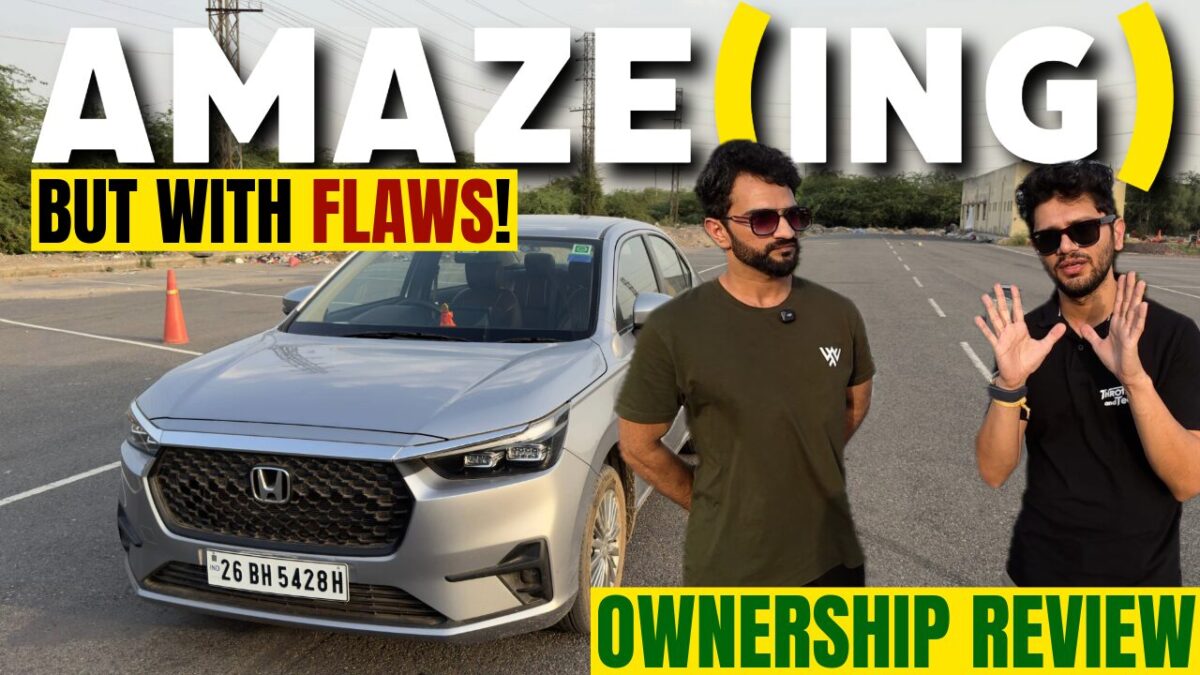
In a market where sub-4m SUVs are eating sedan share for breakfast, this owner walked into showrooms with the Renault Kiger and Skoda Kylaq on his shortlist — and walked out with a Honda Amaze. His reasoning was unfashionably simple: Honda’s engine reliability mattered more than ride height.
He’s not alone, but he’s not in the majority either. Most buyers in this segment have stopped looking at sedans entirely. So the question this review actually answers isn’t “is the Amaze a great car” — it’s “if you’re the kind of buyer who can still see past the SUV hype, what does the VX CVT actually live with like?”
We’ll cover the engine, the cabin, how it drives, the real-world fuel numbers, and the compromises Honda made on the VX trim that the dealership won’t draw your attention to.

How does the Honda Amaze VX CVT drive?
Honda’s 1.2-litre i-VTEC petrol is the headline. 90 PS, 110 Nm, four cylinders, normally aspirated. On paper those numbers look modest in 2026 — a Kylaq’s 1.0 TSI makes more torque, and the Kiger’s turbo makes the Amaze look anaemic on a spec sheet.
In practice, the engine’s character is exactly what Honda buyers come for. It revs cleanly, doesn’t feel strained at the top end, and has none of the lumpy turbo lag that newer rivals exhibit from a standing start. For city driving — start, stop, creep, repeat — that linear delivery is genuinely pleasant.
The CVT changes the story. CVT gearboxes have a reputation for the “rubber band effect” — where you press the accelerator and the engine revs flare without an immediate, proportional jump in road speed. The Amaze’s CVT exhibits this exactly as described. In gentle city driving you barely notice it. On a highway overtake, you very much do.
Out on the open road, the chassis is the surprise. The car feels planted at speed and the steering is honest. High-speed cornering is composed, not nervous. Where the package gives ground is on cabin insulation — at 100-plus, you become aware of the world outside in a way you wouldn’t in something a segment up.
The Honda Amaze VX cabin: where the trim shows its limits
The VX gets you climate control with a Max Cool setting, a clean and functional instrument cluster, and LED projector headlamps that are rare in this part of the segment. The dashboard layout is uncluttered and easy to navigate without taking your eyes off the road for long.
But there are tells that the VX is a mid-trim, not the top one. Exposed screws on the door panels. Some hard plastics in places where the eye lands. Rear headroom that tightens noticeably for adults over six feet. None of these are deal-breakers individually, but together they’re reminders that the ZX exists for a reason.
The biggest VX compromise isn’t cosmetic, though — it’s the one Honda cuts from the spec sheet entirely.
Honda Amaze cruise control: the feature Honda left off the VX
Cruise control is the Amaze ZX’s exclusive on this trim ladder. Climb up to it and you get cruise; stay on VX and you don’t.
For a car whose CVT actively benefits from steady speeds — both for fuel efficiency and for drivetrain smoothness — leaving cruise off the VX is a real ergonomic miss. On a four-hour highway run, holding 90 km/h with a sensitive right foot is exactly the kind of low-level fatigue that ages a road trip.
If you do regular intercity duty, this single feature gap may justify the climb to ZX on its own.
Honda Amaze VX CVT mileage and real-world ownership numbers
The owner reports 12–13 kmpl in the city and 17–18 kmpl on the highway. That’s real-world, not ARAI-mode driving, and it’s competitive — though not class-leading — for a 1.2-litre normally aspirated petrol with a CVT.
The 416-litre boot is genuinely useful and one of the segment’s strongest practical arguments for buying a sedan in 2026. Two large suitcases and a soft bag fit without the rear seats moving. Most sub-4m SUVs in this price bracket can’t say that.
Service costs and parts availability are Honda’s quiet competitive advantage. The brand’s after-sales network and engine reliability story is exactly why this owner sat in Renault and Skoda showrooms and still drove home in the Amaze.
Honda Amaze VX CVT vs Renault Kiger vs Skoda Kylaq
This isn’t a like-for-like comparison. The Kiger and Kylaq are sub-4m SUVs; the Amaze is a sub-4m sedan. The real question is what kind of vehicle you want, not which is “best” on a spec sheet.
The Renault Kiger wins on ride height, ground clearance, and the pseudo-SUV stance the Indian market has rewarded for a decade. The turbo variant out-torques the Amaze on paper. The flip side: Renault’s long-term reliability and after-sales story doesn’t match Honda’s, and that’s the lever this owner pulled.
The Skoda Kylaq wins on engine — the 1.0 TSI is a genuine highlight at this price — and on European-feel build quality. Service network and parts cost are Skoda’s known weaknesses, and that’s the lever this owner pulled again.
The Honda Amaze VX CVT wins on engine reliability, resale value, and the segment’s most usable sedan boot. It loses on outright performance, on stance, and — within its own lineup — on the cruise control and feature parity gap with the ZX.
For a buyer who runs the car for 7–10 years and values predictable ownership over outright excitement, the Honda is the conservative choice this owner deliberately made.