- Actually go off-road — the AllGrip Pro low-range and Brake LSD shame cars costing twice as much
- Want a real body-on-frame 4x4, not a tall hatchback pretending to be one
- Value character over rational metrics — this is a heart purchase and you know it
- Travel to remote India — Maruti's service network reaches where roads end
- Drive mostly solo or as a couple — it's a brilliant two-person adventure vehicle
- Carry a family of four plus luggage regularly — the boot and rear seat won't cope
- Spend most of your time on highways — it's slow, floaty, and noisy above 3,000 RPM
- Need quick overtakes — 105 bhp and a 4-speed auto means you plan passes, not snatch them
- Want daily-driver storage — two cup holders and shallow door pockets, that's it
- Judge a car on value-per-rupee — on a spreadsheet, the Jimny loses every time
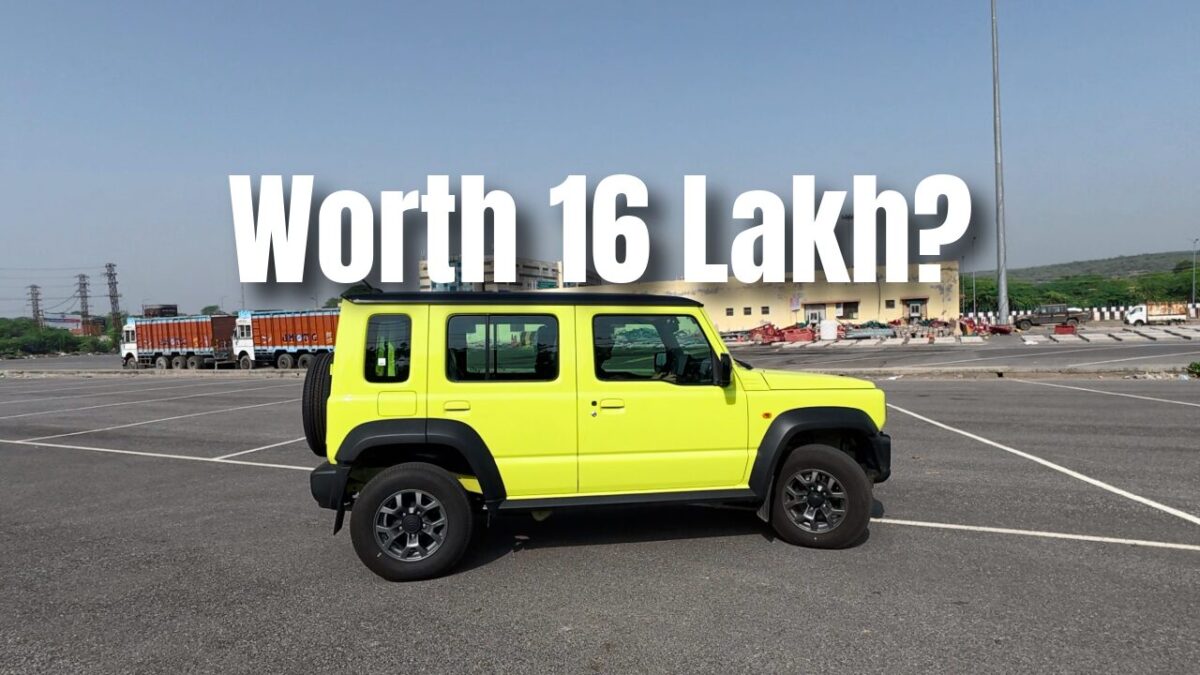
Here’s the strange thing about the Maruti Suzuki Jimny: its demand is almost completely inelastic in the ₹12–20 lakh bracket. Drop the price to ₹12 lakh and you won’t see queues form. Push it to ₹20 lakh and the people who want one will still buy it. That’s not how normal cars behave. It’s how objects of desire behave — and understanding that is the key to deciding whether this ₹16 lakh on-road 4×4 is for you.
We’re reviewing the 2026 Jimny 5-door Alpha AllGrip automatic — the full-fat version with the proper low-range transfer case, Brake LSD, and the 4-speed torque converter. This is a car that scores badly on almost every spreadsheet metric a sensible buyer is supposed to care about, and none of that matters to the people who buy it. The job of this review is to tell you, honestly, which of those two camps you’re in before you put money down.
If the Jimny is on your shortlist, the Maruti PDI Master Blueprint is the inspection tool we’d want before any Maruti delivery — and for the Jimny specifically, there’s one PDI check that genuinely changes how the car drives. More on that below.
The body-on-frame truth — why the Jimny feels different
The Jimny is built on a traditional body-on-frame ladder chassis. In 2026, that makes it a near-extinct species. Almost every “SUV” at this price is a monocoque crossover — a tall hatchback in hiking boots. The Jimny is the real thing: a separate steel ladder frame with a body bolted on top, rigid axles front and rear, and a low-range transfer case that actually means something.
What surprises most people who expect a crude, agricultural machine is the build quality. The doors shut with a solid, expensive-sounding thud. Cabin insulation is genuinely effective at the speeds this car is meant to live at. The K15B 1.5-litre petrol is refined at low RPM — it only gets vocal above 3,000 RPM, which is exactly where you stop wanting to be in this car anyway.
The chassis choice has a cost, and it’s honesty time: a ladder frame is heavier, less efficient, and dynamically lazier on tarmac than a monocoque. The Jimny leans in corners. It’s not quick. It floats a little at the top end. If you wanted a car that carves a highway on-ramp, you were never going to buy this. The ladder frame is the entire point — it’s what makes the off-road ability real instead of marketing.
The PDI check that transforms this car — tyre pressure
This is the single most important thing in this review, and almost no one tells Jimny buyers about it.
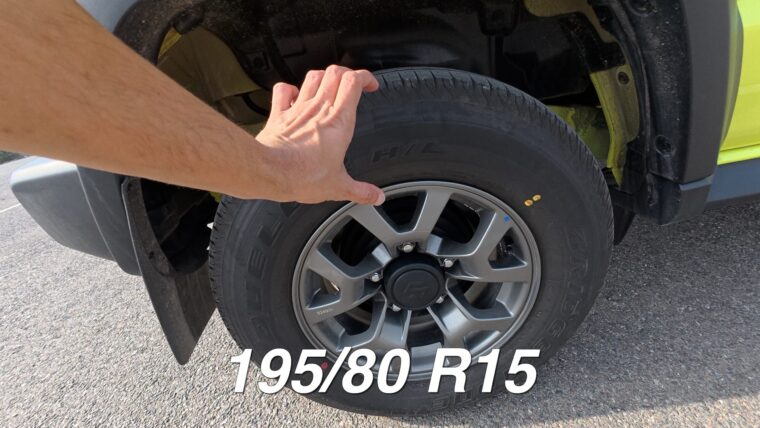
The Jimny rides on tall-sidewall tyres, and that sidewall is a big part of why the ride quality is as good as it is over broken roads. But sidewall flex is extremely sensitive to inflation pressure. Maruti’s recommended pressure for normal use is around 26 PSI. Dealerships routinely deliver the car significantly over-inflated — often in the 40+ PSI range, because higher pressure is easier on tyres sitting in a stockyard and improves showroom fuel-economy numbers.
At delivery pressure, the Jimny rides like a buckboard — every road seam slams through, and buyers conclude “this is just how the Jimny rides.” It isn’t. Drop the tyres to the recommended 26 PSI and the same car turns supple, absorbent, and genuinely comfortable. It is the most dramatic single change you can make to how this car feels, and it costs nothing.
This is exactly the kind of thing a proper PDI catches and a dealer won’t volunteer. The full pre-delivery sequence for the Jimny — including the tyre-pressure check, the 4×4 system engagement test, and the body-panel and underbody inspection that matters more on a car people actually take off-road — is in the Maruti PDI Master Blueprint. ₹1,499 once, no dealership sponsorship, no upsells.
Living with it daily — the space reality
Let’s be blunt about practicality, because this is where the heart-versus-head fight is won or lost.
The Jimny is a strict four-seater, and even that comes with caveats. The rear seat is genuinely usable for two adults on shorter trips, but under-thigh support is poor and it’s tight enough that it’s really a two-people-plus-occasional-rear-passengers car. The boot is small. With the rear seats up, it swallows a couple of soft bags and not much more.
Then there’s the storage problem that every Jimny owner learns within a week. Internal cabin storage is minimal. There are two cup holders — and if both are occupied, you’re holding your cup in your hand, because the door side-pockets don’t have enough usable depth to take a bottle or a cup. It sounds trivial written down. It is not trivial when you live with it. This is a car designed around off-road function, not around the small daily conveniences buyers take for granted in a ₹16 lakh vehicle.
What it gets right for daily use: it’s narrow and nimble, which makes it shockingly easy in dense city traffic and tight parking. Tinted glass keeps cabin heat down. Visibility out of the upright, boxy greenhouse is excellent. The ergonomics are sound. It’s an easy car to potter around town in — just not a car to carry a family of four plus their luggage to a wedding.
The 4-speed automatic — reliable, not rapid
The Jimny AllGrip automatic uses a 4-speed torque converter. Four ratios, in 2026, when rivals offer six or more. On paper it’s archaic. In practice, for this car’s mission, it’s mostly the right call — a torque converter is robust, predictable, and handles low-range crawling off-road far better than a dual-clutch ever could.
The limitation shows up in one specific situation: quick overtakes on the highway. Ask for a sudden burst of speed to pass a truck and the combination of a modest 105 bhp engine and only four gears means the response is leisurely. You plan overtakes in this car; you don’t snatch them. Cruising at a relaxed 80–90 km/h is where the Jimny is happiest, and where it returns its best real-world efficiency.
For the first 1,500 km, treat the engine gently — this naturally aspirated unit rewards a proper running-in, which is what the Engine Break-In Blueprint at ₹999 is built around. The Jimny is a keep-for-a-decade car for most who buy it, so the break-in period matters more than usual.
Off-road — the reason it exists
Everything the Jimny gives up on tarmac, it converts into genuine off-road ability that shames vehicles costing twice as much.
The approach and departure angles (36° and ~46°) are built for clambering over rocks, not for looking aggressive in a mall parking lot. Ground clearance is 210mm. The AllGrip Pro system with its low-range transfer case lets you crawl up genuinely difficult terrain. Hill Hold and Hill Descent Control make steep work manageable even for a relative novice. And the Brake LSD is the clever bit — when a wheel loses grip and starts spinning, it brakes that wheel and redistributes torque to the wheels that still have traction. It’s what lets a light, simple 4×4 walk through situations that strand heavier, more powerful soft-roaders.
The exterior is engineered to take minor hits — pebbles, rocks, branch scrapes — without the owner wincing. This is a vehicle designed to be used, not preserved. That’s rarer than it sounds, and it’s a big part of the emotional pull.
Jimny vs Thar vs Gurkha — pick your compromise
At roughly ₹16 lakh on-road, the Jimny sits in a small, strange club of affordable proper off-roaders, and each member asks you to compromise differently.
The Mahindra Thar is more powerful, has more road presence, and offers a diesel. On tarmac it’s the more imposing, more “look at me” choice. Off the road, the lighter Jimny with its cleverer 4×4 hardware is frequently more capable in the genuinely difficult stuff. The Thar Roxx adds space and features but climbs well past the Jimny on price.
The Force Gurkha matches the Jimny for hardcore capability and arguably exceeds it in some scenarios, but it’s cruder on the road, heavier to drive, and nowhere near Maruti’s service-network reach — which matters enormously if you actually take the thing to remote places.
The Jimny’s trump card is the one nobody else can match: it’s a globally engineered Suzuki backed by Maruti’s service network, which reaches further into rural and remote India than anyone else. For a vehicle whose entire purpose is going where roads get bad, being able to get it serviced in a small town is not a footnote — it’s central to the proposition.
For buyers weighing whether they want rugged at all, our Renault Duster TCe 160 review covers the soft-roader alternative that’s far better on highways. If your honest use is 95% city and tarmac, that comparison is worth reading before you let your heart sign the cheque.
The closing call
The Maruti Suzuki Jimny is an emotional purchase, and that is not an insult — it’s the most accurate thing anyone can say about it. As a rational ₹16 lakh transport appliance, it fails: it’s slow, it’s tight, it’s thirsty for its size, the boot is small, and you’ll hold your coffee in your hand. As an object of genuine character with real, usable off-road ability and a service network that reaches the ends of the map, it’s close to unmatched at any sane price.
If you’ve read this far and the limitations sound like dealbreakers, the Jimny isn’t your car, and no amount of charm should talk you into it. If you’ve read this far and you’re nodding along thinking “yes, but look at it” — then you were always going to buy one, and the only job left is to inspect it properly so you get a good one. The dealer won’t do that for you. The PDI comes first.