
- Do regular highway runs — the 1.5 CRDi + torque converter is the best mid-size diesel automatic at this price
- Want all the toys — dual 12.3-inch displays, full ADAS, ventilated seats, panoramic sunroof, Bose audio in one car
- Drive 1,500+ km a month — only a diesel makes financial sense at that running
- Need a 6-footer's legroom in the back — the K3 platform delivered on rear-seat space
- Value tech over driver involvement — this is a feature-list car, not a driver's car
- Drive mostly in city — the ₹23 lakh premium dilutes when you're doing 30 km a day
- Want a quieter cabin — the 1.5 CRDi has classic diesel clatter at idle and low RPMs
- Need genuine soft-roader ability — 200mm ground clearance is decent on paper, but this is FWD only
- Have ₹23 lakh to spend on a midsize SUV — test-drive an XUV700 AX5 before signing
The Kia Seltos GTX(A) Diesel AT has a number buyers rarely run before walking into the dealership: ₹23.55 lakh on-road in Delhi. ₹22.34 lakh in Ahmedabad. That’s the cheque you write for the top diesel automatic Seltos in 2026 — the variant Kia parks at the top of the price list because it’s the one that gets called “the loaded one” in showroom conversations.
For most of this segment’s existence, the narrative has been “Seltos vs Creta.” At ₹23 lakh on-road, that’s no longer the only comparison that matters. A Mahindra XUV7X0 AX5 or AX7 is opting for manual, the Toyota Hyryder Strong Hybrid, an entry-trim Innova Hycross — all are now in conversation with this Seltos. The question isn’t whether the Seltos is good. It’s whether what it’s good at is what you need at this price.
I drove the GTX(A) Diesel AT in Aurora Black Pearl for this review. The car is competent. The case for buying it is real. But the case is narrower than Kia’s marketing suggests, and the things you should know before signing aren’t in the brochure. If the Seltos is on your shortlist, the Kia PDI Master Blueprint is the inspection tool we’d want before any Kia delivery — paint, electrical, and panel-gap checks tuned for the issues this car specifically tends to surface.
The 1.5 CRDi + 6-speed AT story
Skip the petrol-DCT and petrol-CVT variants – the Seltos GTX(A) Diesel AT exists to make a different argument. The 1.5-litre CRDi puts down 115 PS and 250 Nm through a 6-speed torque converter automatic. On paper these numbers are unremarkable. In practice, they’re the entire reason this variant deserves your attention.
The torque converter is the right gearbox for this car. Unlike Kia’s DCT (which has a documented service footprint), the torque converter is mechanically simple, predictable, and built for how diesels deliver power. There’s no kickdown drama. No clutch-pack hesitation on overtakes. It just goes. Smoothly.
The 250 Nm shows up around 1,500 RPM and stays useful through 2,750 RPM. Highway driving with cruise set is genuinely refined. Urban driving is where the diesel character intrudes most — there’s noticeable clatter at idle and below 1,200 RPM, more than the 7XO diesel. If you’re test-driving from a quiet showroom, do the drive on a real road, not the dealership service lane. The clatter is a deal-breaker for some buyers and a non-issue for others; you need to know which one you are before the booking amount is paid.
Fuel economy during our drive read around 10 kmpl on the MID after city stints. That’s the start of the curve. On steady highway running, the 1.5 CRDi + 6-speed AT realistically delivers 18–20 kmpl — not the ARAI brochure number, but the figure most owners will actually see.
The K3 platform reset — bigger car, bigger considerations
The 2026 Seltos rides on Hyundai-Kia’s K3 platform, and the dimensions changed enough to matter. The car is 95mm longer (4,460mm), 30mm wider (1,830mm), and runs an 80mm longer wheelbase (2,690mm).
Three of those numbers are what buyers came for. Longer wheelbase means real rear-seat space. Wider stance means better high-speed composure. Longer body means the boot finally accommodates two adult suitcases without folding the rear seats. The fourth number — ground clearance — is where Kia’s marketing leans hardest. 200mm sounds impressive in a brochure, but the Seltos is still front-wheel-drive only. No AWD anywhere in the diesel lineup. If you’re considering this for genuine soft-roading, this isn’t the answer.
For pure ride quality, the K3 chassis is the most balanced Seltos yet. The launch-spec car was known for a fidgety ride; this one is genuinely composed at speed. The suspension is firmer than the Hyryder Hybrid but more compliant than a Kushaq feels. It’s a midsize-SUV chassis tuned for highway running, and that’s the use case it serves best.
Inside the cabin — the triple-display story
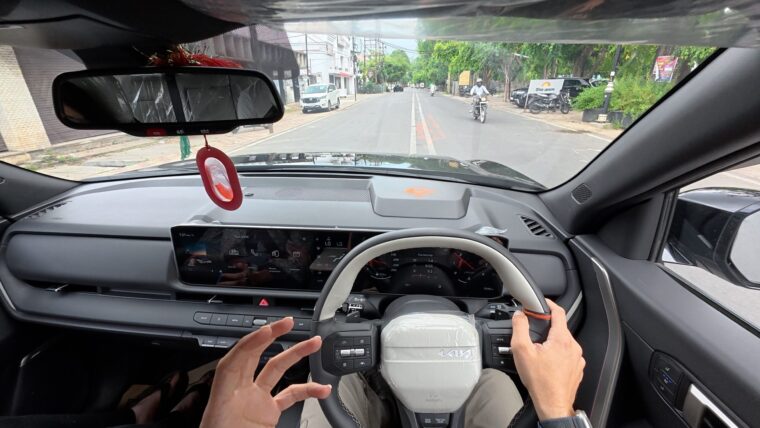
The headline is the dashboard. Two 12.3-inch screens — the instrument cluster on the driver side and the infotainment in the centre — are housed in one panoramic glass panel that visually reads as a single curved display. It’s the most modern dashboard at this price, no contest.
Infotainment is responsive, layouts are clean, and the Bose audio standard on GTX is the best factory-tuned audio in the segment. Wireless Android Auto and Apple CarPlay both work without the cable-pulling drama earlier Hyundai-Kia products had.
What buyers need to know before falling for the dashboard: digital instrument clusters and integrated infotainment panels are the highest-risk component category at PDI. The 2024–25 Seltos has documented instrument cluster failures (Kia issued TSB ELE374 for related electronic issues), and globally, the new Seltos has Consumer Reports trouble spots specifically called out for “infotainment system, backup or other camera/sensors.” These aren’t urban legends. They’re the failure modes a dealer won’t volunteer at handover.
Other GTX(A) cabin highlights worth confirming on your own test drive:
- Two-tone D-cut steering wheel feels right; paddle shifters are real and functional
- Ventilated front seats are a Delhi-summer feature you’ll use every day
- Panoramic sunroof, electric driver seat with two-position memory, aluminium sport pedals — these are real, not chrome trim
- The “Bose premium” badge is real Bose and it sounds it
ADAS is Kia’s full suite — adaptive cruise, lane-keep assist, forward collision warning, blind-spot monitoring.
Rear seat, boot, and the practical compromises
The K3 platform’s extra wheelbase shows up here. Rear legroom is genuinely sufficient for a 6’4″ passenger. Headroom is adequate even with the panoramic sunroof eating ceiling height. The seat-back angle is set right for long drives — not too upright, not too reclined.
Convenience features the GTX gets that lower variants don’t: rear sunshades, coat hangers, rear AC vents with separate controls, USB-C ports on both sides. The middle seat is usable for adults on shorter runs — width is decent — though the central tunnel hump means it’s not a long-distance perch.
The 447-litre boot is competitive. Two large suitcases plus a soft bag fit without folding the rear seats. The 60:40 split lets a fourth passenger sit while you carry a bicycle. What’s missing — and you’ll feel its absence at every petrol pump where you’re balancing the boot lid against the bumper — is an electric tailgate. The XUV7X0 has one. The Innova has one. The Seltos GTX(A) at ₹23 lakh on-road doesn’t. That’s a real omission at this price.
The Kia Seltos quality story — what PDI catches that the brochure doesn’t
This is the part of the article most reviews skip. The Seltos has well-documented owner issues across global markets, and many are exactly the kind of thing a thorough pre-delivery inspection catches before you sign the papers and lose negotiating leverage.
Real Indian PDI experiences have surfaced paint damage that wasn’t there at the first inspection — there are thread documenting paint damage during a second PDI on a Seltos HTX AT Diesel is one of dozens of similar reports across forums. The pattern: car arrives at dealership, sits, gets touched during pre-delivery prep, and paint flaws emerge that the customer wasn’t shown the first time. The lesson isn’t paranoia. It’s that one inspection isn’t enough on a car with this many painted panels.
The 2024–25 Seltos has documented electronic failures: instrument cluster not illuminating on startup (Kia TSB ELE374), key fob battery drain from the welcome function (TSB ELE382), forward collision avoidance system failures, AWD coupling actuator software issues on AWD-equipped trims sold abroad. These are the failures that happen at delivery or shortly after. They’re catchable.
Indian dealerships sometimes deliver vehicles with feature-set discrepancies — vehicle in transit mode, ADAS components not properly activated. The 360-degree camera on the GTX needs to be tested at PDI. The panoramic sunroof needs to be opened, tilted, closed, and reopened at PDI. The ventilated seats need to work at PDI. The wireless charging pad needs to actually charge a phone at PDI. Every feature you paid for needs to be verified before the cheque clears.
These aren’t paranoid concerns — they’re the specific patterns we’ve seen repeated across Kia deliveries in India. The full pre-delivery inspection sequence for the Seltos, with photo references for what each issue looks like and dealer-deflection scripts for when the SA tries to wave you off, is in the Kia PDI Master Blueprint. ₹1,499 once, no dealership sponsorship, no upsells. Buying a ₹23 lakh on-road car without it is a bigger gamble than most buyers realise.
Seltos GTX(A) Diesel AT vs Creta vs XUV7X0 — the comparison that actually matters
At ₹23 lakh on-road, the Seltos isn’t competing only with the Hyundai Creta anymore. It’s in conversation with cars buyers used to think were a segment up.
The Hyundai Creta Diesel AT is the natural cross-shop. Same Hyundai-Kia 1.5 CRDi engine, same 6-speed torque converter, same platform underneath. The Creta King Diesel AT is similarly priced, has a 3-star Global NCAP rating unlike the Seltos, and is the safer bet for resale value.
The Mahindra XUV7X0 AX5 Diesel AT is the segment-up alternative that fits a Seltos GTX(A) buyer’s budget. The XUV7X0 has a more powerful engine (2.2-litre diesel). The Seltos’s defence here is a more modern and polished cabin and a full fat L2 ADAS pack.
The Toyota Hyryder Hybrid is the running-cost-first answer. 26–28 kmpl real-world makes the diesel premium calculation tighter than it looks on paper. The Hyryder doesn’t have the Seltos’s cabin tech, but the strong-hybrid powertrain and Toyota service economics close the gap meaningfully over 7–10 years of ownership.
For buyers wondering whether they need this much car: our Skoda Kylaq Prestige review covers the sub-4m alternative at roughly half the on-road price — same buyer, less car. For buyers wondering whether to go more rugged at the same money: the Renault Duster TCe 160 review is the genuine soft-roader option in the same price band.
The closing call
The Kia Seltos GTX(A) Diesel AT is a quietly competent diesel automatic SUV that earns its price for a specific buyer: highway-heavy, tech-loving, willing to live with diesel clatter at idle, comfortable with a 5-star BNCAP rating, and content with FWD-only practicality. For that buyer, this is one of the most resolved diesel automatic SUVs at this price.
For anyone else, the ₹23 lakh on-road number deserves to be tested against the alternatives — especially the XUV7X0 — before signing on the dotted line. And if the Seltos is what you end up with, do the PDI properly. The dealer won’t. The first 1,500 km after that matter more than people realise on a new diesel, which is what the Engine Break-In Blueprint at ₹999 is for — but the inspection comes first.